
I made a two-dimensional simulation of relativistic length contraction using QBASIC.
Category Archives: Physics
Why doesn’t plastic dry in the dishwasher?

Ceramics and glasses dry perfectly well in the dishwasher, but plastic items seem to remain steadfastly wet
Physics exam tips

Physics exam tips. See my latest blog post!
Deriving the speed of light from Maxwell’s Equations
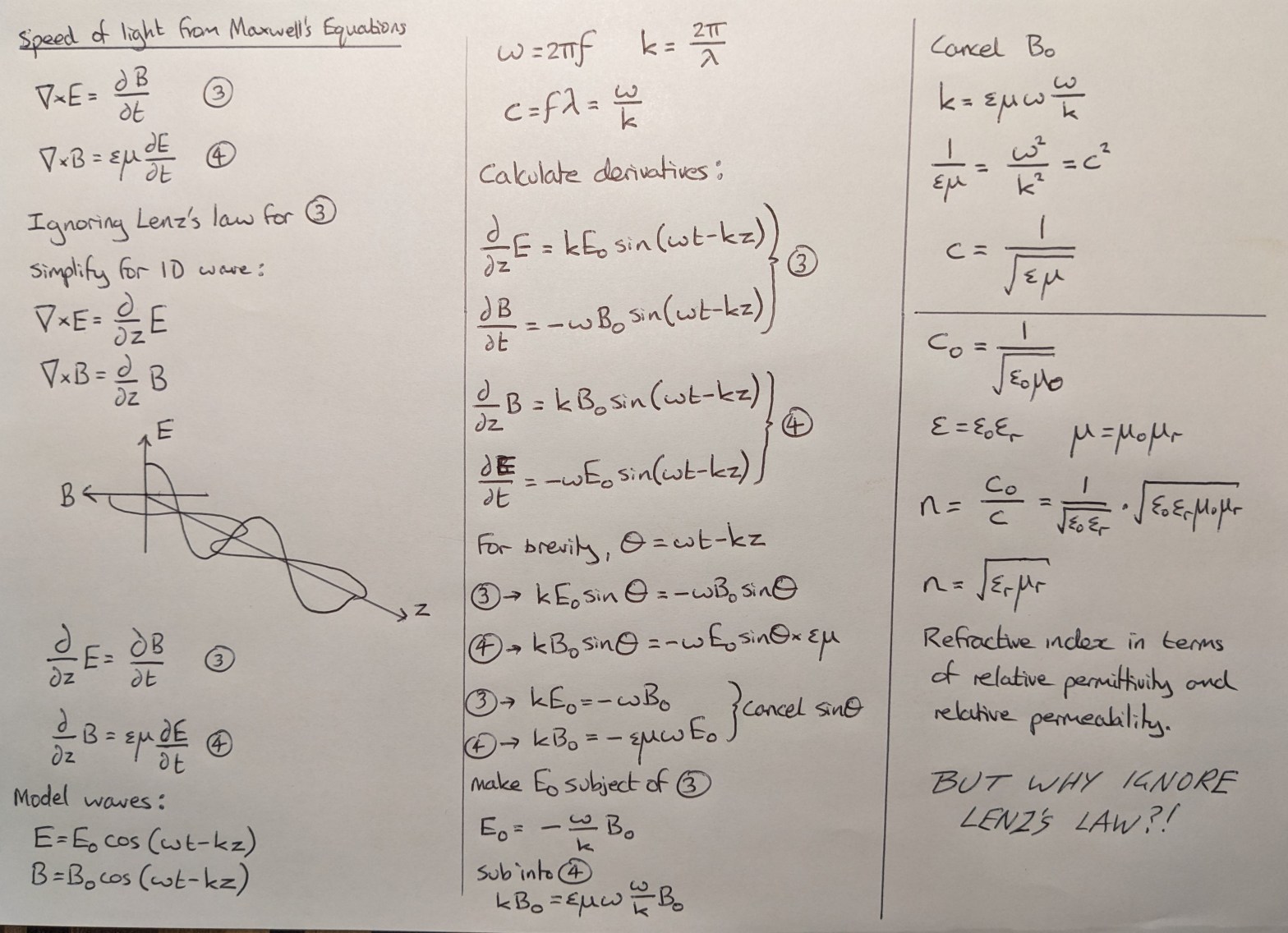
I thought it’d be good to show my A-Level students how to model an electromagnetic wave using a sinusoidal wave function for the electric and magnetic fields, and how these can be substituted into Maxwell’s Equations to derive the speed of light. There are a few ways to derive the speed of light from Maxwell’sContinueContinue reading “Deriving the speed of light from Maxwell’s Equations”
Doing the same thing

In a Year 12 lesson on Tuesday I realised that I was asking the students to perform a simple experiment they’d done twice before: once in Year 7 and once in Year 10. Of course, this time around it was to be more complex because we were going to use light gates, but still theContinueContinue reading “Doing the same thing”
A line of best fit can be curved to be straight

I’ve heard that teachers of mathematics tell their students that a line is always straight, and so a line of best fit is always straight. I’ve heard that teachers of mathematics say that there are also curves of best fit, but that these are not lines, because they are not straight. Consider a graph showingContinueContinue reading “A line of best fit can be curved to be straight”
Ultraviolet catastrophe

According to the Rayleigh-Jeans’ Law, Eq 1: Rayleigh-Jeans Law where B is the power emitted let unit area per unit solid angle per unit wavelength for a given wavelength and temperature, T is the temperature of the body, lambda is the wavelength of radiation emitted by the body, and k is Boltzmann’s constant. This classicalContinueContinue reading “Ultraviolet catastrophe”
Laws that are laws until they’re not laws

Here are a few Laws from Physics that don’t always work.
Liquid crystal displays (LCDs)

These types of displays work in a clever way. Light passes through a polarising filter, through a liquid crystal, and then through a second polarising filter with the plane if polarisation orientated 90° to the first. The light then reflects off a mirror and follows the return path through the polarising filter, liquid crystal andContinueContinue reading “Liquid crystal displays (LCDs)”
The Mother of the Nuclear Atom

Lise Meitner’s first duty was to science. From a supportive and encouraging childhood, she grew into one of the most remarkable physicists of the 20th Century, whilst keeping her moral integrity intact.
 Physics with Keith