Have you ever noticed on a dark and frosty morning that if you look at a street light it appears to have a glowing halo around it?
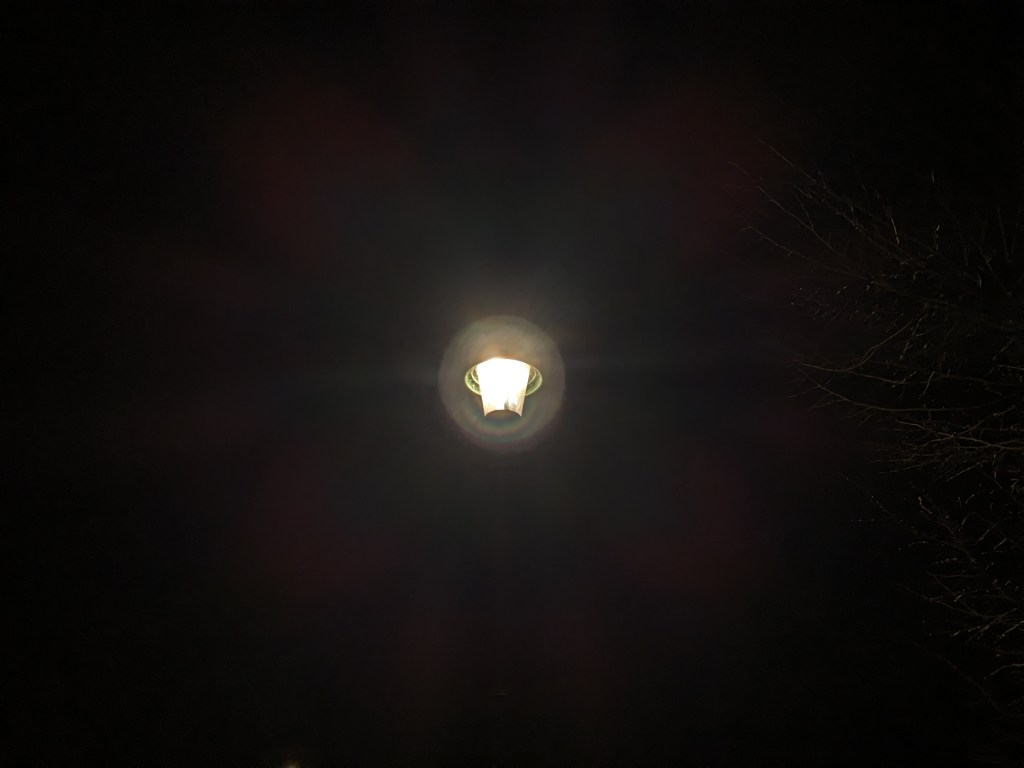
Cameras just cannot capture that halo the same way your eye does. There is a reason for that. The halo is actually an effect caused by your eye, rather than light scattering off cold humid air. You can prove this by eclipsing the light source with a finger. If the light was scattering off the air, you would still see the glow around the source of light.

No glow, so the glow must have originated in your eye. A photograph cannot capture the effect because it requires the measuring instrument to be an eye. The glowing halo measured by the eye is caused by the eye.
This is an example of the observer effect in physics; the act of making a measurement changes the measurement being made. A good example is when using a voltmeter. We assume voltmeters have infinite resistance, so that no current passes through them. If no current passes through them, then adding a voltmeter to a circuit does not change the current flowing through any part of the circuit. A voltmeter has a very high resistance, but it is not infinite, so adding a voltmeter across a component reduces the overall resistance between the two points in the circuit where the voltmeter is connected. If there are two resistors in series, and a voltmeter is connected in parallel with one of the resistors, then the share of resistance of the other resistor increases, increasing its share of the potential difference and decreasing the potential difference across the two points where the voltmeter is connected. The act of measuring the potential difference across a component with a voltmeter reduces the potential difference.
Another example is using a barometer to measure a gas pressure. Barometers work by allowing something to be moved when pushed by the pressurised gas; however if something moves that increases the volume of the gas, decreasing the gas pressure. The act of measuring the pressure of a gas reduces the gas pressure.
For an extreme case, imagine we are measuring the length of a piece of string. We hold up an extremely high-resolution ruler (what we used to call a ‘precise ruler’ before exam boards decided to change the meaning of the word precise), one that can measure the position of the atoms on each side of the string to within a few femtometres – this hypothetical ruler does not exist, of course, but let us imagine it does. In order to judge which mark on the ruler’s scale aligns with the atoms at the end of the string, we need light to bombard the end of the string, illuminating the string so that the position of the atoms can be measured. Photons carry momentum, so the positions of the atoms at the end of the string are affected. Measuring the length of a piece of string changes the length of the piece of string (but in every day situations, the difference is so laughably minuscule it can be neglected).
It is important to note, the observer effect should not be confused with the measurement problem in quantum physics.
In astronomy, we have to be careful of measurement artifacts. Diffraction spikes of stars can be a problem, for example, especially if they obscure something else; however, we can use diffraction spikes of stars to help us resolve double stars which would otherwise be too close together to resolve. Any sort of astrophotography involves recording where light falls on some sort of sensor, whether that be photographic film or a CCD. Both of these methods of recording images have noise, but this noise can be taken into account if it is first sampled.
Next time you see a glow around a light at night, eclipse it with a finger and marvel that the light you saw was being diffracted within your eye itself.
 Physics with Keith