In 1804 John Leslie, a Scottish physicist, invented a way of investigating thermal emissivity. It’s a simple experiment; you have a cube with different coloured and textured surfaces on the faces, you fill it with hot water and you observe the intensity of infrared radiation emitted from each surface.

Hot water is used in the hollow cube so that each face is in contact with the same temperature water. The different faces will thus be at the same temperature if enough time is allowed for thermal equilibrium between the faces and the water to be achieved. It means each face will be at the same temperature as the water within.
Dark surfaces radiate more infrared radiation than light surfaces. Matte surfaces radiate more infrared radiation than shiny surfaces.
You can see from the image below that the matte black face radiates far more intense infrared radiation than the shiny side. Which even reflects infrared radiation emitted by the hand.

The thermal image uses false colour, where red indicates high intensity infrared radiation and blue indicates low intensity infrared radiation, with green in the middle. This isn’t the best false colour scheme to use because it is not accessible for individuals with deuteranomaly (red-green colour vision deficiency), but that was the image I found on Wikipedia showing a Leslie’s cube working well. Here’s mine:
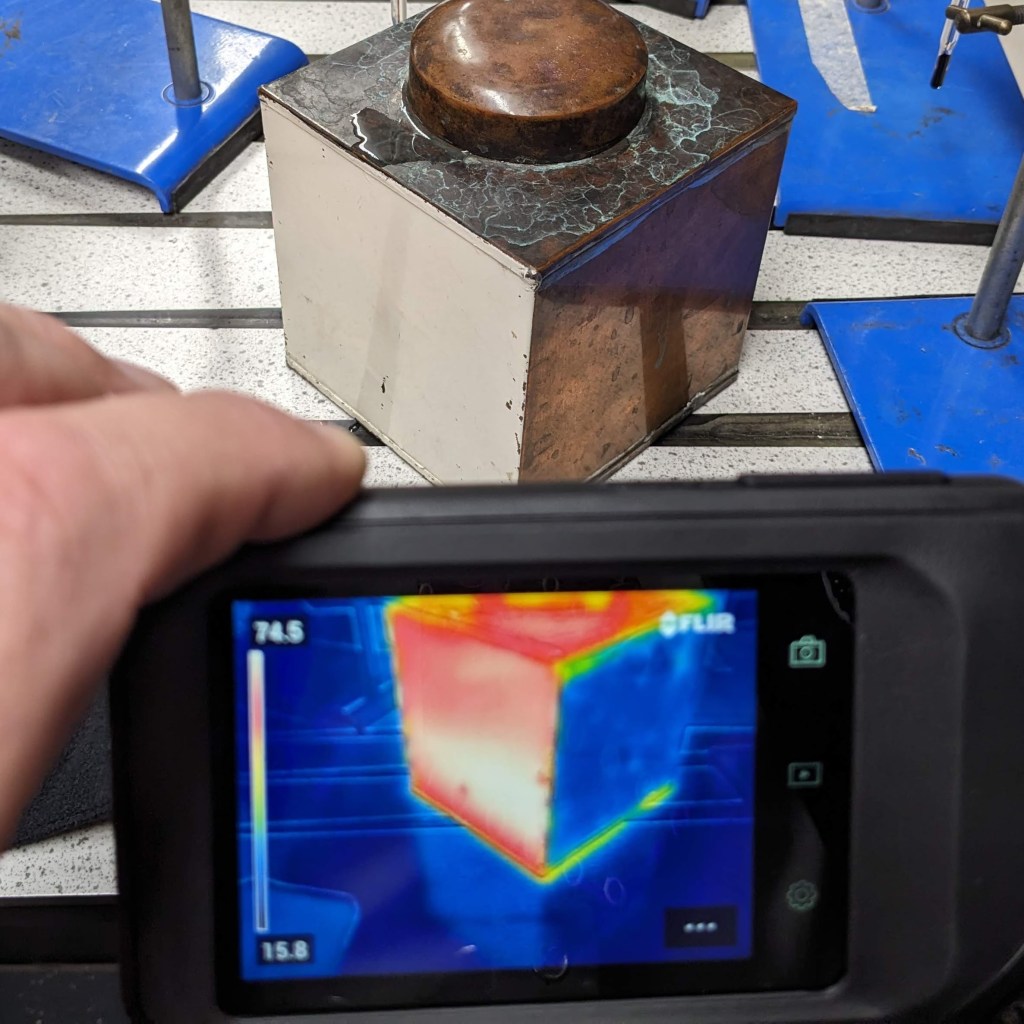
Uh oh. The white face appears to be emitting more intense infrared radiation than the dark face. If you look more closely, you’ll notice the dark face is bare brass or copper metal and is perhaps slightly more shiny than the white-painted side, but it’s not convincing at all. Worse still:
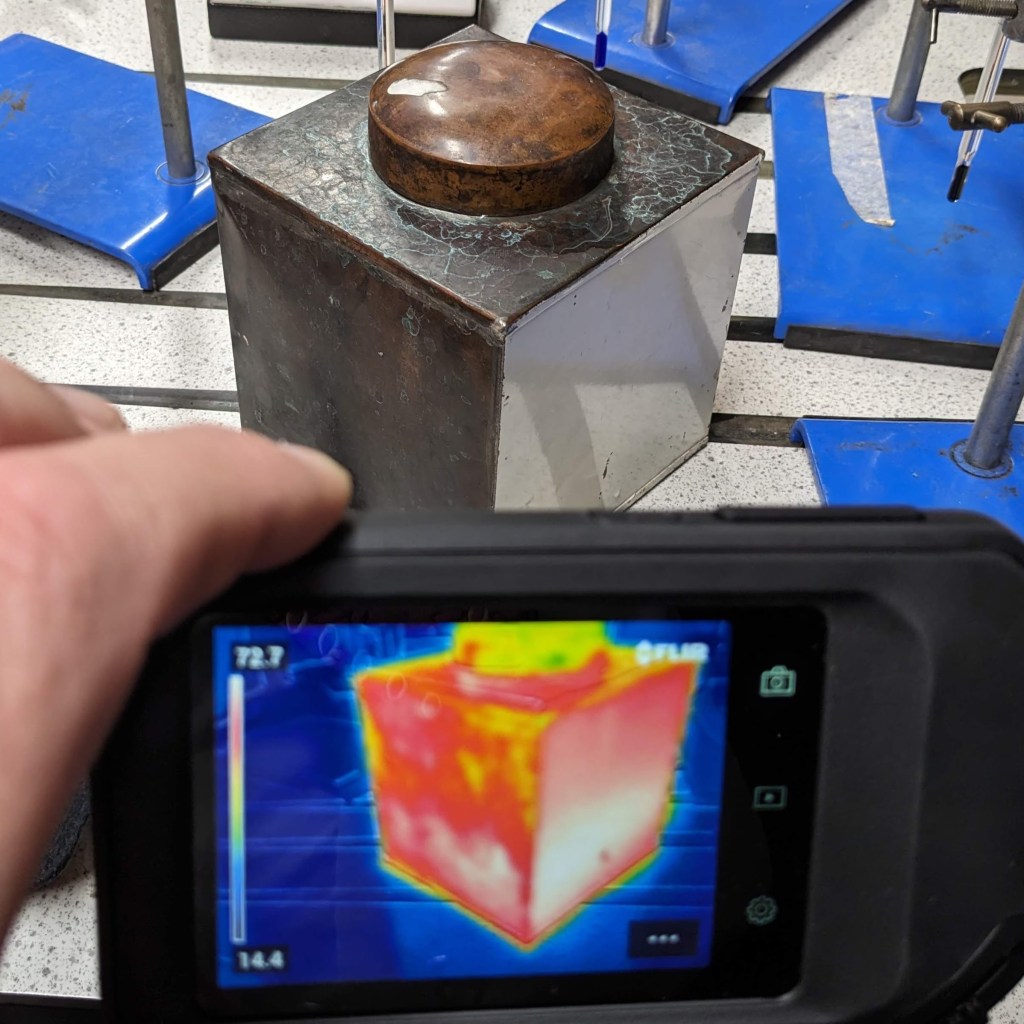
Now that is definitely a matte dark face emitting less intense infrared radiation than a shiny white face. Uh oh.
This is one of the two Leslie’s cubes at my school. The other works far better but I keep forgetting to label which one is the good one so whether I get good results or not is a 50:50 chance each time.
There is more to surface emissivity than just colour and shininess. When using a good quality infrared thermal camera, there is usually an option to correct the temperature scale for the surface emissivity, from 0 to 1.
An emissivity of 0 means a surface that perfectly reflects all electromagnetic radiation incident upon it. Polished shiny surfaces can have an emissivity as low as 0.1. Oxidised surfaces, like the tarnished metal on my Leslie’s cube, have an emissivity of about 0.5. Matte painted surfaces can have an emissivity as high as 0.9 (an emissivity of 1 would be a perfect black body). Two bodies at the same temperature with different surface emissivities will show as having different temperatures on a thermal camera or infrared thermometer. It’s a fact worth knowing.
 Physics with Keith

