Here are a few Laws from Physics that don’t always work.
Hooke’s Law
Hooke’s Law states that the restoring force exerted by a spring on whatever is pulling on its free end is directly proportional to minus the extension or compression on the spring. Alternatively, it is often stated instead as the force on a spring is directly proportional to its extension or compression (no minus). Because of Newton’s Third Law, either statement is fine. But, there’s a bit more to Hooke’s Law than that.

Hooke’s Law also states that it only applies for extensions or compressions below the elastic limit of the spring. In most materials, the relationship between force and extension or compression is linear for extensions or compressions below the elastic limit (or thereabouts). In other words, Hooke’s Law states that it is valid until it is not valid. Plenty of materials don’t obey Hooke’s Law at all; rubber is a good example. Well below the elastic limit the relationship between force and extension or compression is nonlinear. So Hooke’s Law isn’t a universal law.
Ohm’s Law
Ohm’s Law states that the electric current through an electrical component is directly proportional to the potential difference across the component. As the resistance of a component is defined as the potential difference across it divided by the current through it, Ohm’s Law states that resistance of a component is constant.
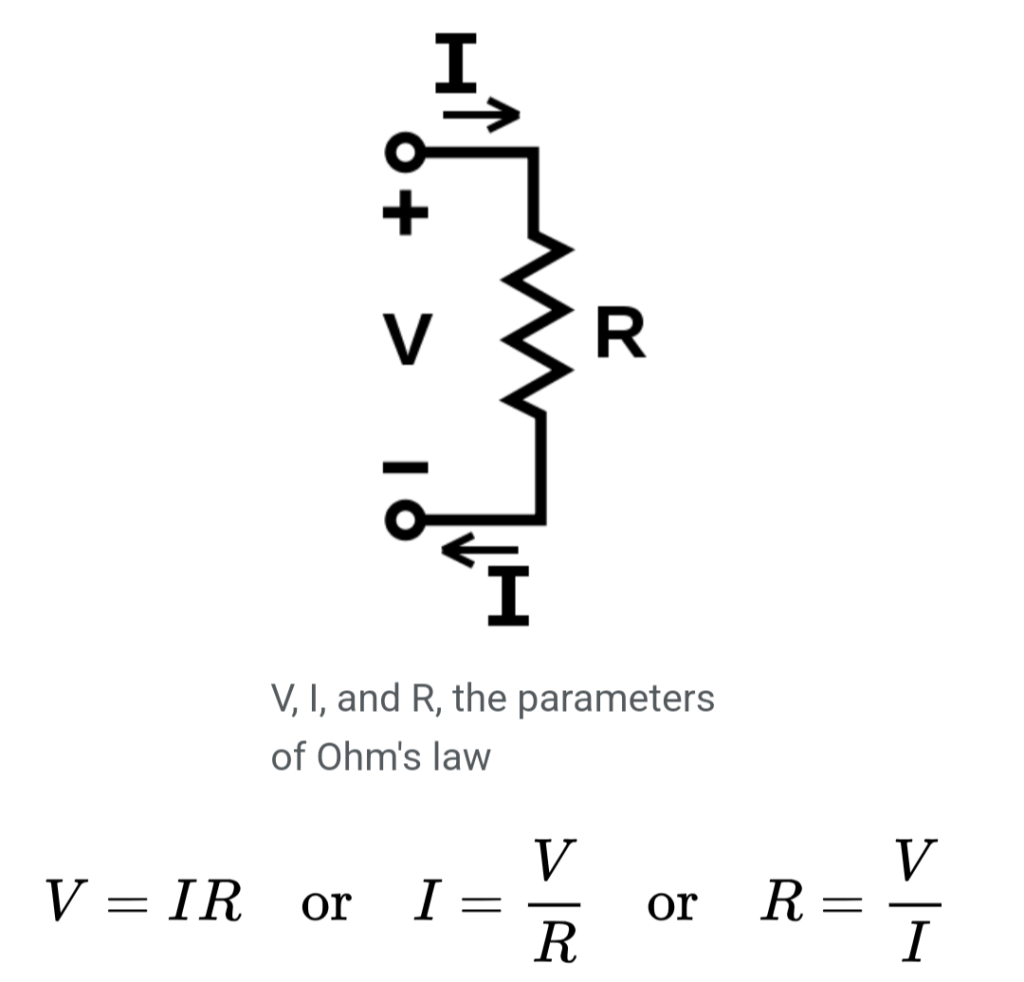
But Ohm’s Law is usually stated with conditions attached; it is only valid for components whose resistance does not depend on the current through the component. When a current passes through a conductor, it has a heating effect. For some conductors, such as metals, their resistance increases as the temperature of the conductor increases. For semiconductors, often the resistance reduces as the temperature increases. For some extrinsic semiconductors, such as diodes, the resistance is entirely dependent on the potential difference across the component or, once conducting in forward bias, the current through the component. So essentially Ohm’s Law states that Ohm’s Law applies for components where Ohm’s Law applies. That’s fantastic.
The First Law of Thermodynamics
This is what the Law of Conservation of Energy is sometimes called. It’s a simple law: the total energy in an isolated system before some change is equal to the total energy in the system after some change. Let’s ignore the fact that Einstein’s famous equation E=mc² breaks this law. Emmy Noether explained where the law comes from in terms of symmetry. In fact, Emmy Noether explained where all conservation laws come from in terms of symmetry. For the other conservation laws (momentum, charge, etc), they derived from different continuous symmetries. If a system has a continuous symmetry property under some change then there is a corresponding conserved quantity associated with that change.

Spatial translational symmetry begets conservation of momentum. Rotational symmetry begets conservation of angular momentum. Symmetry of the phase factor of the complex field of a charged particle and the associated gauge of the potentials begets conservation of electric charge (phew).
For each change, the Lagrangian is preserved. A Lagrangian is basically an expression for the total energy of a system. Here’s the issue. Each conservation rule can be derived by examining a different symmetry and identifying how to make the Lagrangian invariant. For translational symmetry, the Lagrangian is invariant when momentum is conserved. For rotational symmetry, the Lagrangian is invariant when angular momentum is conserved. Energy is conserved when the Lagrangian is invariant in time-symmetric changes, but the Lagrangian is the energy, and each conservation rule derives from its invariance. So the reasoning is circular, and a gross simplification could be simply: ‘energy is conserved when energy is conserved’.
Newton’s Law of Universal Gravitation
I won’t say much about this. It doesn’t work. It was used to predict the existence of the planet Vulcan, which was proposed to exist between the Sun and Mercury. Einstein’s General Relativity fixed our understanding of gravity.
The Ideal Gas Law
… and the experimental gas laws. They only work for ideal gases, but at low temperatures, forces between particles become too significant, and the laws break down.
Oh, there are loads more, but this post is long enough for now.
Reminder: Weekly Live Tuition Sessions!
SATURDAY 28th March 2026
| GCSE Physics | 9:30am | Transformers |
| A-Level Physics | 10:30am | Transformers |
| GCSE Astronomy | 11:30am | Stellar evolution (1) |
If you wish to enrol on the tuition sessions and haven’t yet, then click enrol below
 Physics with Keith

