In a Year 12 lesson on Tuesday I realised that I was asking the students to perform a simple experiment they’d done twice before: once in Year 7 and once in Year 10. Of course, this time around it was to be more complex because we were going to use light gates, but still the experiment was basically the same: confirm conservation of energy when an object is dropped by comparing its gravitational potential energy before it is dropped to the kinetic energy it gains before it hits the floor. I decided to spice it up a bit and invited Year 12s with aspirations to get an A* grade to come to the front of the lab to learn how conservation of energy is used in mechanics in the first year of an undergraduate physics degree course. I was surprised when the whole class came to the front, abandoning the practical. So, I delivered a short introduction to Lagrangian mechanics.
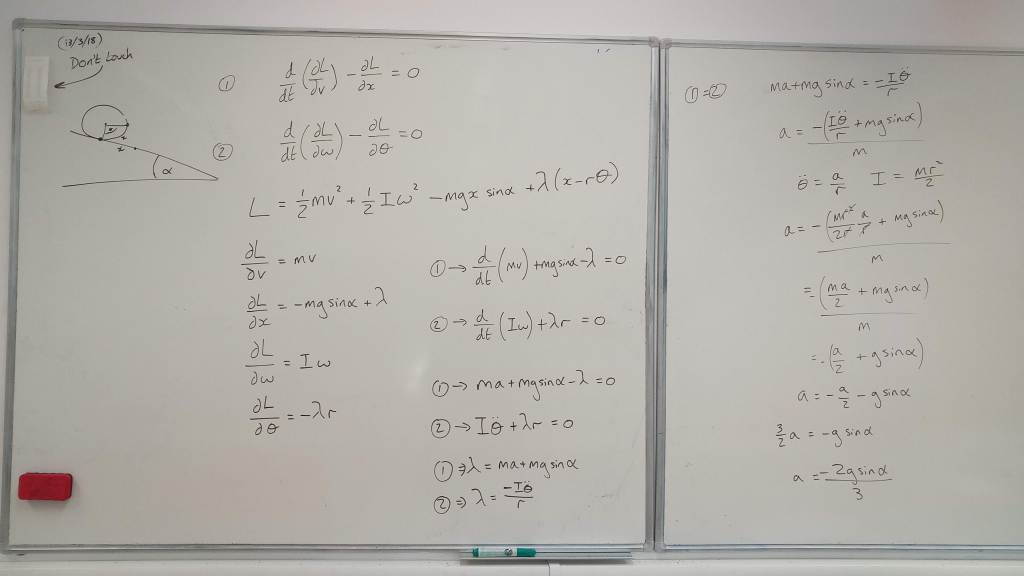
I posed them the problem of determining the acceleration of a solid uniform cylinder rolling down an inclined plane.
If we only consider translational kinetic energy and gravitational potential energy, then:
a = g sin 𝜶
where 𝜶 is the angle of the inclined plane. With a solid cylinder, however, it will also experience an angular acceleration as it descends, increasing the angular kinetic energy too. This can easily be handled with Lagrangian mechanics, where the Lagrangian is the sum of the energies when potential energies are taken to be negative and kinetic energies are positive.
This approach requires knowledge of circular motion, which they hadn’t done yet, and partial derivatives, which they hadn’t done yet either.
We ran out of time before getting a solution (my fault for forgetting a crucial step) but it gave them a good introduction into a wider world of mechanics beyond the basic SUVAT equations and using basic calculus to derive the equations of motion.
I’ll record a video about this when I can, but in the meantime, here’s a photo of the whiteboard the last time I solved this problem, back in 2019.
Reminder: Weekly Live Tuition Sessions!
SATURDAY 28th March 2026
| GCSE Physics | 9:30am | Transformers |
| A-Level Physics | 10:30am | Transformers |
| GCSE Astronomy | 11:30am | Stellar evolution (1) |
If you wish to enrol on the tuition sessions and haven’t yet, then click enrol below
 Physics with Keith