Here we go, some bad physics for you, courtesy of Boardworks.
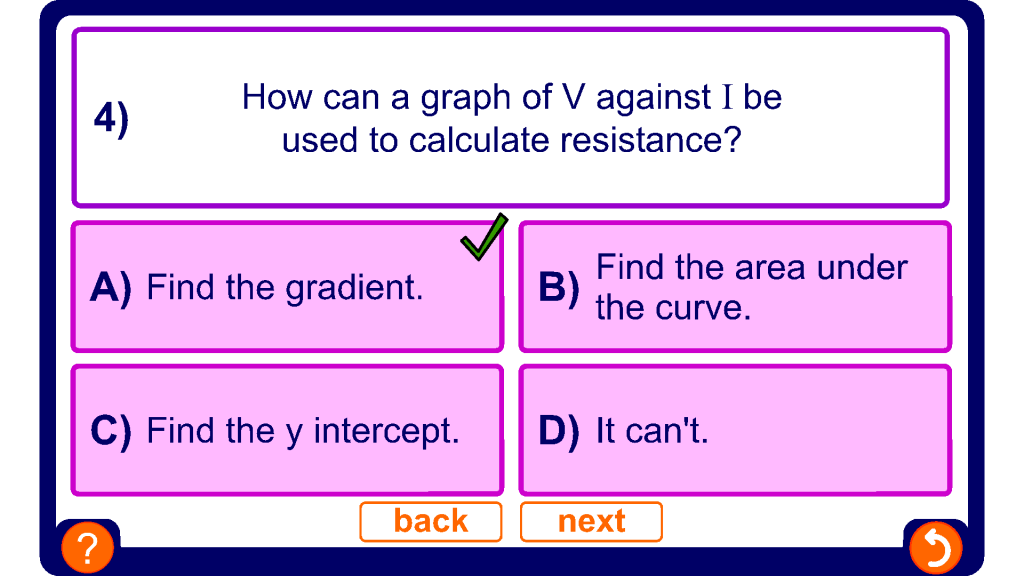
No, the gradient of a V-I graph is not the resistance. It is true that V=IR, so R=V/I, but for the gradient to be equal to R, the equation V=IR must describe a straight line graph that passes through the origin (V=IR in the form y=mx+c where V is plotted on the y-axis, I is plotted on the x-axis, and the y-intercept is zero. In that case, R would be the gradient). That is only the case for fixed resistors. It does not work for any other component.
Consider the diode. Characteristics are usually plotted with current on the y-axis and potential difference on the x-axis. According to Boardworks, the reciprocal of the gradient would be the resistance. That is simply untrue. Look at the characteristics graph for the diode below:
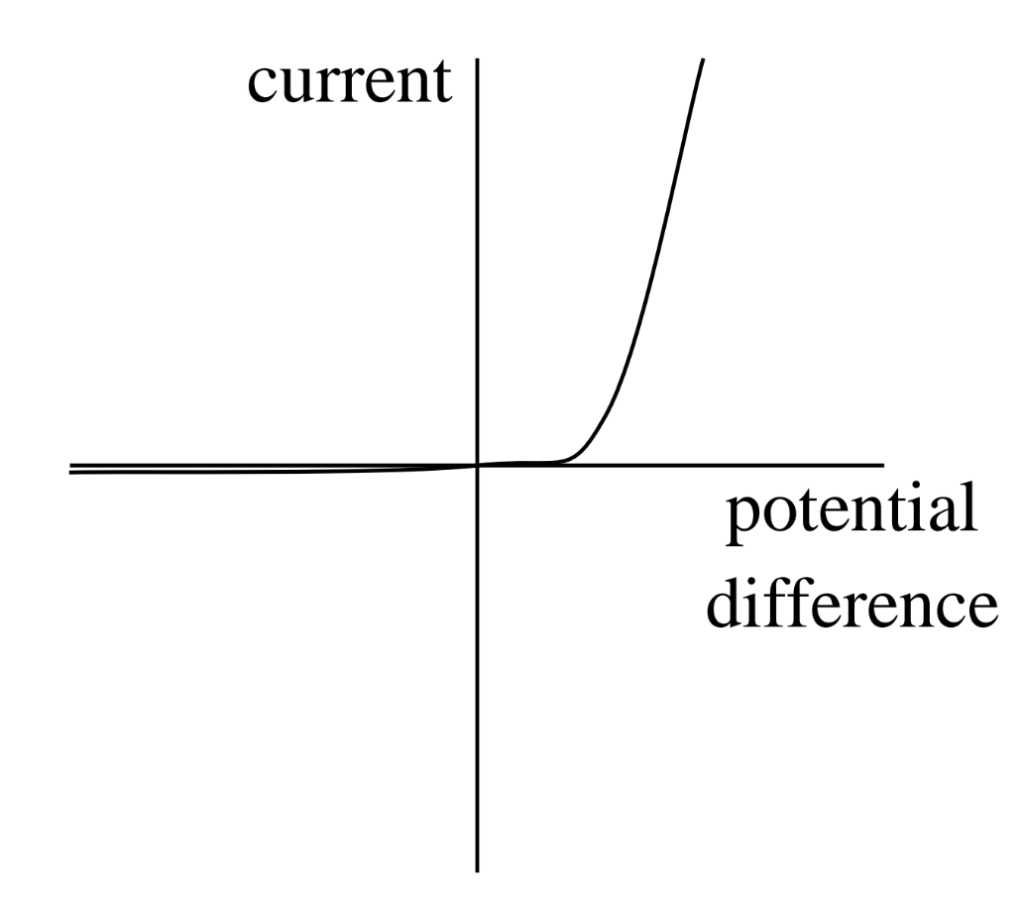
After the knee, which is at about 0.7V for silicon diodes, the line becomes pretty straight. Boardworks would have you believe that the resistance would not change beyond this potential difference because the gradient does not change, and the gradient is the reciprocal of the resistance. Boardworks is wrong. The resistance of the diode decreases as the current through it increases. The resistance is calculated by taking a single point along that characteristic curve and dividing the potential difference by the current. That’s it. Nothing to do with gradient.
Ah, but I have seen exam questions where students had to state that an increase in gradient indicates a reduction in resistance. That may work for filament lamps, but that does not work for diodes because a constant gradient does not indicate a constant resistance at all.
I could probably have worded this post better, but I think you get the point. Boardworks has produced resources with incorrect physics. Exam boards give credit for answers that display incorrect physics too.

Reminder: Weekly Live Tuition Sessions!
SATURDAY 28th March 2026
| GCSE Physics | 9:30am | Transformers |
| A-Level Physics | 10:30am | Transformers |
| GCSE Astronomy | 11:30am | Stellar evolution (1) |
If you wish to enrol on the tuition sessions and haven’t yet, then click enrol below
 Physics with Keith