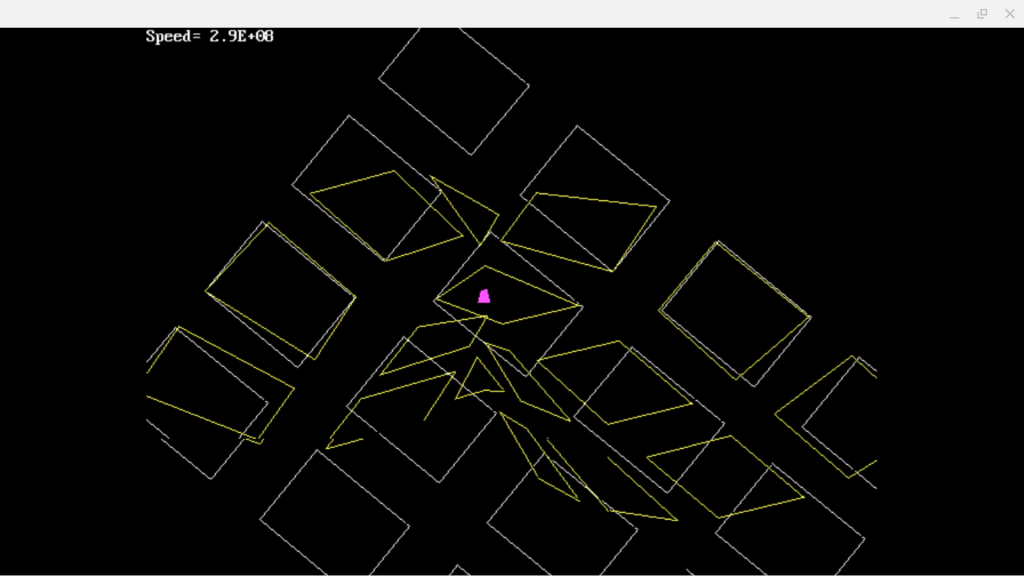
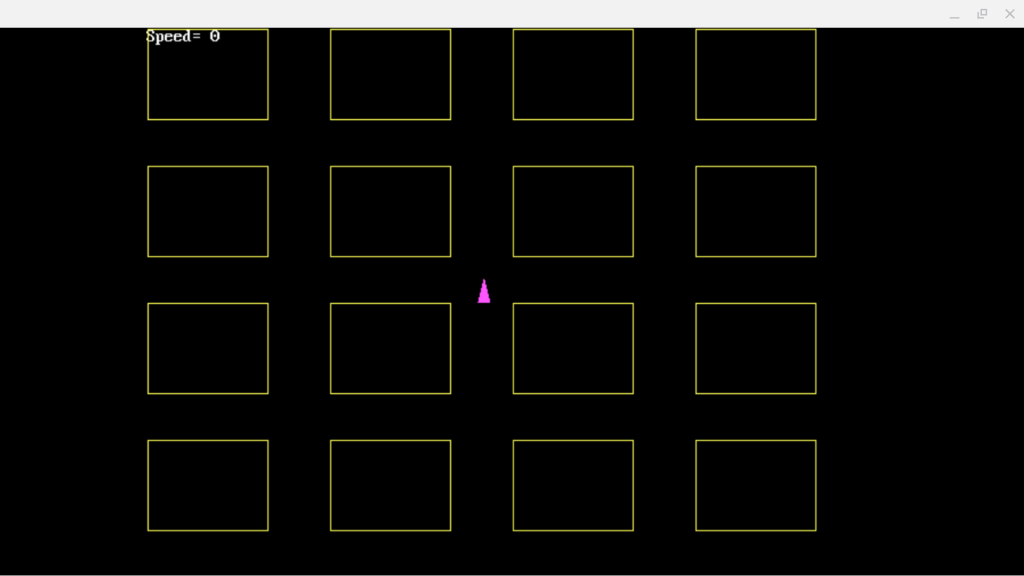
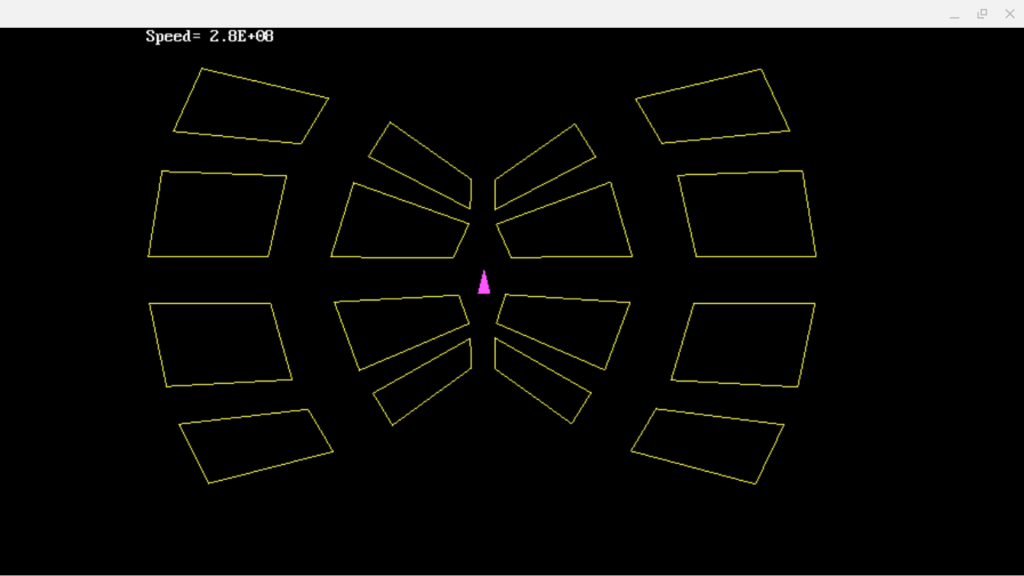
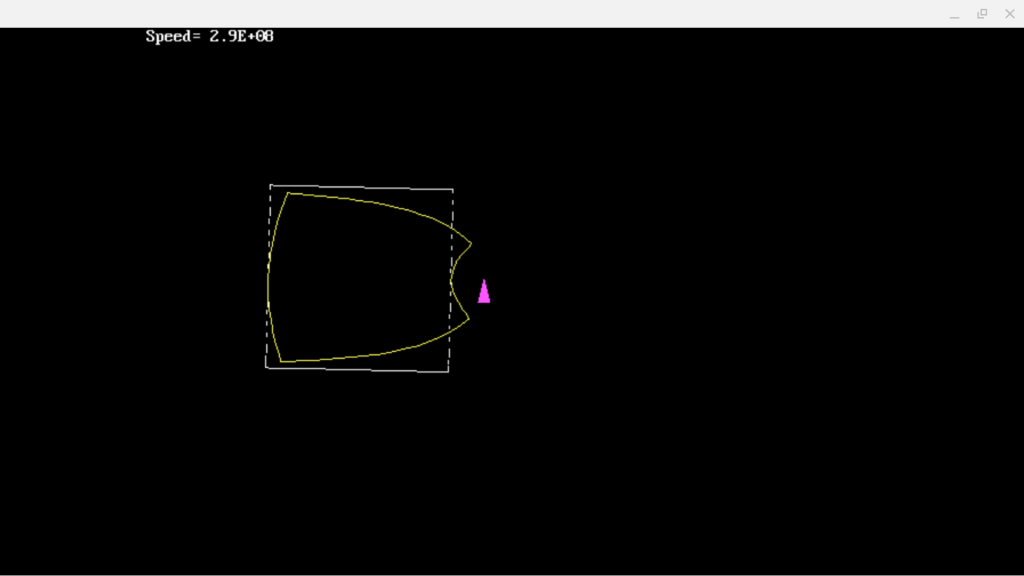
I created a program so that students can visualise relativistic length contraction better. When we teach it in Year 13 to our students, we teach that the proper length is contracted by a factor gamma, which depends on the relative speed of the observer and the body being observed. The problem is, this is all a bit too one-dimensional.
This visualisation was inspired by the MIT game called A Slower Speed of Light (available here). In that game, players must collect magic watermelons or something to slow down the speed of light, making relativistic effects observable. There were a few issues with the game. Firstly, it’s a game, and collecting the magic watermelons is tedious when I just want to show something to students. Secondly, the game is in 3-D, making it a little too resource-intensive for my work laptop. I could bring my nice gaming laptop from home to run it, but I would prefer not to. Since my old pink laptop died, I’ve been looking for alternatives.
I was able to get A Slower Speed of Light to run on my Chromebook, believe it or not, at about 0.5 frames per second. It’s unplayable, and the tedium of collecting magic watermelons is augmented my the poor frame rate and slow response time of the controls. Nevertheless, running it within BOX64, I was able to get it to run.
But, hey, I’m a programmer (of sorts), so surely I could whip something up myself?
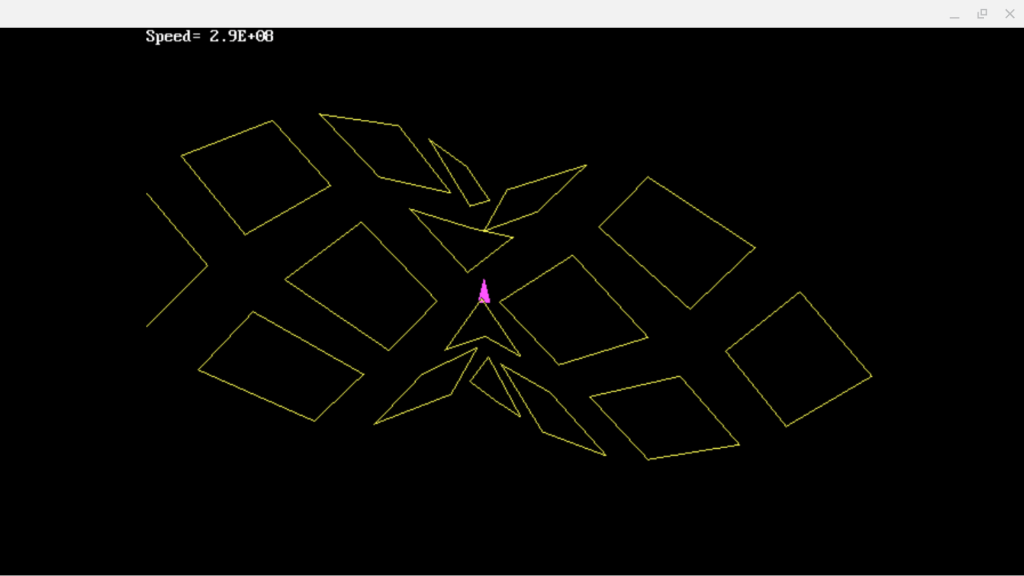
A few hours later, and here we have it. A two-dimensional simulation that runs pretty well. It uses Dosbox to run QuickBASIC 4.5, but don’t hold that against me. I started coding in BASIC when I was eight years old and I never really grew out of it (a colleague once remarked that they stopped using BASIC when they ‘grew up’. Well, I haven’t).
I like BASIC. It’s clear, easy to understand, and fairly forgiving. Sure, I could code this in Java, but I’d have to learn Java first. Or C++, but I’d have to learn C++ first. Or Python with Pygame, but I’d… you get the point. I have coded in C before, and Python lots, but I don’t like them and I’d spend so long looking up syntax that it really isn’t worth it for what I wanted to do. BASIC did what I wanted. BASIC is fine.
Watch the video below!
If you want to play with it yourself, open Dosbox, install QBASIC or QuickBASIC, and save the code below in plain text as a .BAS file. Open and enjoy.
Click here to view the QBASIC code, as bad as it is!
DECLARE FUNCTION DISTANCETOVERTEX! (xposition AS SINGLE, yposition AS SINGLE, xvertex AS SINGLE, yvertex AS SINGLE)
DECLARE FUNCTION ATAN2! (x AS SINGLE, y AS SINGLE)
DECLARE FUNCTION GAMMA! (speedis AS SINGLE)
DECLARE FUNCTION SPEED! (xvelocity AS SINGLE, yvelocity AS SINGLE)

'CONST showoriginalgrid = 0
DIM shapepoint(1 TO 16, 1 TO 5, 1 TO 2) AS SINGLE
DIM oldtransformedshapepoint(1 TO 16, 1 TO 5, 1 TO 2) AS SINGLE
DIM transformedshapepoint(1 TO 16, 1 TO 5, 1 TO 2) AS SINGLE
DIM oldviewshapepoint(1 TO 16, 1 TO 5, 1 TO 2) AS SINGLE
DIM viewshapepoint(1 TO 16, 1 TO 5, 1 TO 2) AS SINGLE
DIM perspective AS INTEGER
DIM vieworiginal AS INTEGER
DIM shapetoview AS INTEGER

DIM KS(255), SC(255), DU(255)

FOR E = 0 TO 127
        SC(E) = E
        DU(E) = 1
NEXT E
FOR E = 128 TO 255
        SC(E) = E - 128
        DU(E) = 0
NEXT E

CONST pi = 3.141592653499997#

SCREEN 12

CLS

DIM xvelocity AS SINGLE
DIM yvelocity AS SINGLE

DIM directiontovertex AS SINGLE
DIM directiontovelocity AS SINGLE
DIM resolutionangle AS SINGLE
DIM gammatovertex AS SINGLE
DIM speedtovertex AS SINGLE
DIM contracteddistancetovertex AS SINGLE
DIM speedmove AS SINGLE
DIM xposition AS SINGLE
DIM yposition AS SINGLE
DIM oldxposition AS SINGLE
DIM oldyposition AS SINGLE
DIM angularvelocity AS SINGLE

LET xvelocity = 0
LET yvelocity = 0

LET speedmove = 0

LET xposition = 295
LET yposition = 220
LET perspective = 3
LET vieworiginal = 0
LET shapetoview = 1

' Initialise shapes
FOR shapenumber = 1 TO 16
        FOR vertex = 1 TO 5
                READ shapepoint(shapenumber, vertex, 1), shapepoint(shapenumber, vertex, 2)
        NEXT vertex
NEXT shapenumber

DIM Ik AS INTEGER

DO
        LOCATE 1, 1: COLOR 15: PRINT "Speed="; speedmove; "     "
        I$ = INKEY$
        Ik = INP(&H60)
        KS(SC(Ik)) = DU(Ik)

        SELECT CASE I$
                CASE "q"
                        END
                CASE "Q"
                        END
        END SELECT

        IF KS(72) = 1 THEN
                LET speedmove = speedmove + 1E+07
                IF speedmove >= 299999999 THEN LET speedmove = 299999999
        END IF
        IF KS(80) = 1 THEN
                LET speedmove = speedmove - 1E+07
                IF speedmove <= -299999999 THEN LET speedmove = -299999999
        END IF
        IF KS(77) = 1 THEN
                LET angularvelocity = angularvelocity - pi / 256
        END IF
        IF KS(75) = 1 THEN
                LET angularvelocity = angularvelocity + pi / 256
        END IF

        IF I$ = "f" THEN LET angularvelocity = 0

        LET directiontovelocity = directiontovelocity + angularvelocity
        IF directiontovelocity > 2 * pi THEN LET directiontovelocity = directiontovelocity - 2 * pi
        IF directiontovelocity < 0 THEN LET directiontovelocity = directiontovelocity + 2 * pi

        LET xvelocity = speedmove * COS(directiontovelocity)
        LET yvelocity = speedmove * SIN(directiontovelocity)

        FOR shapenumber = 1 TO 16
                FOR vertex = 1 TO 5
                        LET directiontovertex = ATAN2((shapepoint(shapenumber, vertex, 2) - yposition), (shapepoint(shapenumber, vertex, 1) - xposition))
                        LET resolutionangle = directiontovertex - directiontovelocity
                        LET speedtovertex = speedmove * COS(resolutionangle)
                        LET gammatovertex = GAMMA(speedtovertex)
                        LET contracteddistancetovertex = DISTANCETOVERTEX(xposition, yposition, shapepoint(shapenumber, vertex, 1), shapepoint(shapenumber, vertex, 2)) / gammatovertex
                        IF perspective = 3 THEN
                                LET transformedshapepoint(shapenumber, vertex, 1) = xposition + contracteddistancetovertex * SIN(directiontovertex)
                                LET transformedshapepoint(shapenumber, vertex, 2) = yposition + contracteddistancetovertex * COS(directiontovertex)
                                LET viewshapepoint(shapenumber, vertex, 1) = shapepoint(shapenumber, vertex, 1)
                                LET viewshapepoint(shapenumber, vertex, 2) = shapepoint(shapenumber, vertex, 2)
                        ELSE
                                LET transformedshapepoint(shapenumber, vertex, 1) = 295 + contracteddistancetovertex * SIN(resolutionangle)
                                LET transformedshapepoint(shapenumber, vertex, 2) = 220 + contracteddistancetovertex * COS(resolutionangle)
                                LET viewshapepoint(shapenumber, vertex, 1) = 295 + DISTANCETOVERTEX(xposition, yposition, shapepoint(shapenumber, vertex, 1), shapepoint(shapenumber, vertex, 2)) * SIN(resolutionangle)
                                LET viewshapepoint(shapenumber, vertex, 2) = 220 + DISTANCETOVERTEX(xposition, yposition, shapepoint(shapenumber, vertex, 1), shapepoint(shapenumber, vertex, 2)) * COS(resolutionangle)
                        END IF
                NEXT vertex
        NEXT shapenumber
        IF perspective = 3 THEN
                LINE (oldxposition - 23, oldyposition - 23)-(oldxposition + 23, oldyposition + 23), 0, BF
                DRAW "BM" + STR$(CINT(xposition)) + "," + STR$(CINT(yposition))
                DRAW "C13 NM+0,+0 M+5,+20 M-10,+0 M+5,-20 BM+0,+10 P13,13"
                DRAW "TA" + STR$(CINT(directiontovelocity * 180 / pi))
        ELSE
                LINE (290, 220)-(300, 240), 0, BF
                DRAW "BM" + STR$(CINT(295)) + "," + STR$(CINT(220))
                DRAW "C13 NM+0,+0 M+5,+20 M-10,+0 M+5,-20 BM+0,+10 P13,13"
        END IF
        LET oldxposition = xposition
        LET oldyposition = yposition

        FOR shapenumber = 1 TO 16
                FOR vertex = 1 TO 4
                        LINE (oldtransformedshapepoint(shapenumber, vertex, 1), oldtransformedshapepoint(shapenumber, vertex, 2))-(oldtransformedshapepoint(shapenumber, vertex + 1, 1), oldtransformedshapepoint(shapenumber, vertex + 1, 2)), 0
                        IF vieworiginal = 1 THEN
                                LINE (oldviewshapepoint(shapenumber, vertex, 1), oldviewshapepoint(shapenumber, vertex, 2))-(oldviewshapepoint(shapenumber, vertex + 1, 1), oldviewshapepoint(shapenumber, vertex + 1, 2)), 0
                                LINE (viewshapepoint(shapenumber, vertex, 1), viewshapepoint(shapenumber, vertex, 2))-(viewshapepoint(shapenumber, vertex + 1, 1), viewshapepoint(shapenumber, vertex + 1, 2)), 15
                        END IF
                        LINE (transformedshapepoint(shapenumber, vertex, 1), transformedshapepoint(shapenumber, vertex, 2))-(transformedshapepoint(shapenumber, vertex + 1, 1), transformedshapepoint(shapenumber, vertex + 1, 2)), 14

                NEXT vertex
         NEXT shapenumber
         FOR shapenumber = 1 TO 16
                FOR vertex = 1 TO 5
                        LET oldtransformedshapepoint(shapenumber, vertex, 1) = transformedshapepoint(shapenumber, vertex, 1)
                        LET oldtransformedshapepoint(shapenumber, vertex, 2) = transformedshapepoint(shapenumber, vertex, 2)
                        IF perspective = 1 THEN
                                LET oldviewshapepoint(shapenumber, vertex, 1) = viewshapepoint(shapenumber, vertex, 1)
                                LET oldviewshapepoint(shapenumber, vertex, 2) = viewshapepoint(shapenumber, vertex, 2)
                        END IF
                NEXT vertex
        NEXT shapenumber

        FOR shapenumber = 1 TO 16
                FOR vertex = 1 TO 4
                        LINE (transformedshapepoint(shapenumber, vertex, 1), transformedshapepoint(shapenumber, vertex, 2))-(transformedshapepoint(shapenumber, vertex + 1, 1), transformedshapepoint(shapenumber, vertex + 1, 2)), 14

                NEXT vertex

        NEXT shapenumber


        LET timenow = TIMER
        DO: LOOP UNTIL timenow + .025 <= TIMER


        LET xposition = xposition - yvelocity / 5E+07
        LET yposition = yposition - xvelocity / 5E+07

        IF xposition < 10 THEN LET xposition = 630
        IF xposition > 630 THEN LET xposition = 10
        IF yposition < 10 THEN LET yposition = 470
        IF yposition > 470 THEN LET yposition = 10

        IF I$ = "p" THEN WHILE INKEY$ = "": WEND

        IF I$ = "b" THEN
        '
        END IF

        IF I$ = "s" THEN
                IF shapetoview = 1 THEN
                        FOR shapenumber = 1 TO 16
                                FOR vertex = 1 TO 5
                                        READ shapepoint(shapenumber, vertex, 1), shapepoint(shapenumber, vertex, 2)
                                NEXT vertex
                        NEXT shapenumber
                        LET shapetoview = 3
                        CLS
                END IF
                IF shapetoview = 2 THEN
                        RESTORE
                        FOR shapenumber = 1 TO 16
                                FOR vertex = 1 TO 5
                                        READ shapepoint(shapenumber, vertex, 1), shapepoint(shapenumber, vertex, 2)
                                NEXT vertex
                        NEXT shapenumber
                        LET shapetoview = 1
                        CLS
                END IF
                IF shapetoview = 3 THEN LET shapetoview = 2

        END IF

        IF I$ = "v" THEN
                CLS
                IF perspective = 1 THEN LET perspective = 4
                IF perspective = 3 THEN LET perspective = 1
                IF perspective = 4 THEN LET perspective = 3
        END IF
        IF I$ = "o" THEN
                CLS
                IF vieworiginal = 0 THEN LET vieworiginal = 2
                IF vieworiginal = 1 THEN LET vieworiginal = 0
                IF vieworiginal = 2 THEN LET vieworiginal = 1
        END IF

LOOP UNTIL I$ = "q"

'Rectangle array

DATA 1,1
DATA 106,1
DATA 106,80
DATA 1,80
DATA 1,1

DATA 161,1
DATA 266,1
DATA 266,80
DATA 161,80
DATA 161,1

DATA 321,1
DATA 426,1
DATA 426,80
DATA 321,80
DATA 321,1

DATA 481,1
DATA 586,1
DATA 586,80
DATA 481,80
DATA 481,1

DATA 1,121
DATA 106,121
DATA 106,200
DATA 1,200
DATA 1,121

DATA 161,121
DATA 266,121
DATA 266,200
DATA 161,200
DATA 161,121

DATA 321,121
DATA 426,121
DATA 426,200
DATA 321,200
DATA 321,121

DATA 481,121
DATA 586,121
DATA 586,200
DATA 481,200
DATA 481,121

DATA 1,241
DATA 106,241
DATA 106,320
DATA 1,320
DATA 1,241

DATA 161,241
DATA 266,241
DATA 266,320
DATA 161,320
DATA 161,241

DATA 321,241
DATA 426,241
DATA 426,320
DATA 321,320
DATA 321,241

DATA 481,241
DATA 586,241
DATA 586,320
DATA 481,320
DATA 481,241

DATA 1,361
DATA 106,361
DATA 106,440
DATA 1,440
DATA 1,361

DATA 161,361
DATA 266,361
DATA 266,440
DATA 161,440
DATA 161,361

DATA 321,361
DATA 426,361
DATA 426,440
DATA 321,440
DATA 321,361

DATA 481,361
DATA 586,361
DATA 586,440
DATA 481,440
DATA 481,361

'Big square

DATA 240,160
DATA 250,160
DATA 260,160
DATA 270,160
DATA 280,160

DATA 280,160
DATA 290,160
DATA 300,160
DATA 310,160
DATA 320,160

DATA 320,160
DATA 330,160
DATA 340,160
DATA 350,160
DATA 360,160

DATA 360,160
DATA 370,160
DATA 380,160
DATA 390,160
DATA 400,160

DATA 400,160
DATA 400,170
DATA 400,180
DATA 400,190
DATA 400,200

DATA 400,200
DATA 400,210
DATA 400,220
DATA 400,230
DATA 400,240

DATA 400,240
DATA 400,250
DATA 400,260
DATA 400,270
DATA 400,280

DATA 400,280
DATA 400,290
DATA 400,300
DATA 400,310
DATA 400,320

DATA 240,320
DATA 250,320
DATA 260,320
DATA 270,320
DATA 280,320

DATA 280,320
DATA 290,320
DATA 300,320
DATA 310,320
DATA 320,320

DATA 320,320
DATA 330,320
DATA 340,320
DATA 350,320
DATA 360,320

DATA 360,320
DATA 370,320
DATA 380,320
DATA 390,320
DATA 400,320

DATA 240,160
DATA 240,170
DATA 240,180
DATA 240,190
DATA 240,200

DATA 240,200
DATA 240,210
DATA 240,220
DATA 240,230
DATA 240,240

DATA 240,240
DATA 240,250
DATA 240,260
DATA 240,270
DATA 240,280

DATA 240,280
DATA 240,290
DATA 240,300
DATA 240,310
DATA 240,320

FUNCTION ATAN2 (x AS SINGLE, y AS SINGLE)

        DIM baseangle AS SINGLE
        DIM result AS STRING
        CONST pi = 3.141592653499998#

        LET result$ = "Undetermined"

        IF x = 0 AND y > 0 THEN
                LET ATAN2 = pi / 2
                LET result$ = "Determined"
        END IF

        IF x = 0 AND y < 0 THEN
                LET ATAN2 = 3 * pi / 2
                LET result$ = "Determined"
        END IF

        IF x > 0 AND y = 0 THEN
                LET ATAN2 = 0
                LET result$ = "Determined"
        END IF

        IF x < 0 AND y = 0 THEN
                LET ATAN2 = pi
                LET result$ = "Determined"
        END IF

        IF result$ = "Determined" THEN EXIT FUNCTION

        LET baseangle = ATN(ABS(y) / ABS(x))

        IF x > 0 AND y > 0 THEN ATAN2 = baseangle
        IF x < 0 AND y > 0 THEN ATAN2 = pi - baseangle
        IF x < 0 AND y < 0 THEN ATAN2 = pi + baseangle
        IF x > 0 AND y < 0 THEN ATAN2 = 2 * pi - baseangle

END FUNCTION

FUNCTION DISTANCETOVERTEX (xposition AS SINGLE, yposition AS SINGLE, xvertex AS SINGLE, yvertex AS SINGLE)
        DISTANCETOVERTEX = SQR((xvertex - xposition) ^ 2 + (yvertex - yposition) ^ 2)
END FUNCTION

FUNCTION GAMMA (speedis AS SINGLE)
        CONST c = 3E+08
        IF speedis < 3E+08 THEN
                LET GAMMA = 1 / SQR(1 - (speedis / c) ^ 2)
        ELSE
                LET GAMMA = 3E+38
        END IF
END FUNCTION

FUNCTION SPEED (xvelocity AS SINGLE, yvelocity AS SINGLE)
        LET SPEED = SQR(xvelocity ^ 2 + yvelocity ^ 2)
END FUNCTION
Addendum, 2025-05-23:
Soon after writing this blog post, and as a personal challenge to myself, I decided to translate the code into Python. It isn’t pretty, but it works fine. I forgot to update this post until a blogger eidm wrote a post about Special Relativity and included a link to this very post. So, below is the python code I wrote. Enjoy!
Click here to view the Python code
import math
import numpy
import pygame
import sys
from pygame.locals import * # No idea what this does, but you need it for QUIT

def initialise_shape_arrays(shapepoint, shapeis):
    if shapeis == 1:
        shapepoint[0, 0, 0] = 1
        shapepoint[0, 1, 0] = 106
        shapepoint[0, 2, 0] = 106
        shapepoint[0, 3, 0] = 1
        shapepoint[0, 4, 0] = 1
        shapepoint[1, 0, 0] = 161
        shapepoint[1, 1, 0] = 266
        shapepoint[1, 2, 0] = 266
        shapepoint[1, 3, 0] = 161
        shapepoint[1, 4, 0] = 161
        shapepoint[2, 0, 0] = 321
        shapepoint[2, 1, 0] = 426
        shapepoint[2, 2, 0] = 426
        shapepoint[2, 3, 0] = 321
        shapepoint[2, 4, 0] = 321
        shapepoint[3, 0, 0] = 481
        shapepoint[3, 1, 0] = 586
        shapepoint[3, 2, 0] = 586
        shapepoint[3, 3, 0] = 481
        shapepoint[3, 4, 0] = 481
        shapepoint[4, 0, 0] = 1
        shapepoint[4, 1, 0] = 106
        shapepoint[4, 2, 0] = 106
        shapepoint[4, 3, 0] = 1
        shapepoint[4, 4, 0] = 1
        shapepoint[5, 0, 0] = 161
        shapepoint[5, 1, 0] = 266
        shapepoint[5, 2, 0] = 266
        shapepoint[5, 3, 0] = 161
        shapepoint[5, 4, 0] = 161
        shapepoint[6, 0, 0] = 321
        shapepoint[6, 1, 0] = 426
        shapepoint[6, 2, 0] = 426
        shapepoint[6, 3, 0] = 321
        shapepoint[6, 4, 0] = 321
        shapepoint[7, 0, 0] = 481
        shapepoint[7, 1, 0] = 586
        shapepoint[7, 2, 0] = 586
        shapepoint[7, 3, 0] = 481
        shapepoint[7, 4, 0] = 481
        shapepoint[8, 0, 0] = 1
        shapepoint[8, 1, 0] = 106
        shapepoint[8, 2, 0] = 106
        shapepoint[8, 3, 0] = 1
        shapepoint[8, 4, 0] = 1
        shapepoint[9, 0, 0] = 161
        shapepoint[9, 1, 0] = 266
        shapepoint[9, 2, 0] = 266
        shapepoint[9, 3, 0] = 161
        shapepoint[9, 4, 0] = 161
        shapepoint[10, 0, 0] = 321
        shapepoint[10, 1, 0] = 426
        shapepoint[10, 2, 0] = 426
        shapepoint[10, 3, 0] = 321
        shapepoint[10, 4, 0] = 321
        shapepoint[11, 0, 0] = 481
        shapepoint[11, 1, 0] = 586
        shapepoint[11, 2, 0] = 586
        shapepoint[11, 3, 0] = 481
        shapepoint[11, 4, 0] = 481
        shapepoint[12, 0, 0] = 1
        shapepoint[12, 1, 0] = 106
        shapepoint[12, 2, 0] = 106
        shapepoint[12, 3, 0] = 1
        shapepoint[12, 4, 0] = 1
        shapepoint[13, 0, 0] = 161
        shapepoint[13, 1, 0] = 266
        shapepoint[13, 2, 0] = 266
        shapepoint[13, 3, 0] = 161
        shapepoint[13, 4, 0] = 161
        shapepoint[14, 0, 0] = 321
        shapepoint[14, 1, 0] = 426
        shapepoint[14, 2, 0] = 426
        shapepoint[14, 3, 0] = 321
        shapepoint[14, 4, 0] = 321
        shapepoint[15, 0, 0] = 481
        shapepoint[15, 1, 0] = 586
        shapepoint[15, 2, 0] = 586
        shapepoint[15, 3, 0] = 481
        shapepoint[15, 4, 0] = 481
        shapepoint[0, 0, 1] = 1
        shapepoint[0, 1, 1] = 1
        shapepoint[0, 2, 1] = 80
        shapepoint[0, 3, 1] = 80
        shapepoint[0, 4, 1] = 1
        shapepoint[1, 0, 1] = 1
        shapepoint[1, 1, 1] = 1
        shapepoint[1, 2, 1] = 80
        shapepoint[1, 3, 1] = 80
        shapepoint[1, 4, 1] = 1
        shapepoint[2, 0, 1] = 1
        shapepoint[2, 1, 1] = 1
        shapepoint[2, 2, 1] = 80
        shapepoint[2, 3, 1] = 80
        shapepoint[2, 4, 1] = 1
        shapepoint[3, 0, 1] = 1
        shapepoint[3, 1, 1] = 1
        shapepoint[3, 2, 1] = 80
        shapepoint[3, 3, 1] = 80
        shapepoint[3, 4, 1] = 1
        shapepoint[4, 0, 1] = 121
        shapepoint[4, 1, 1] = 121
        shapepoint[4, 2, 1] = 200
        shapepoint[4, 3, 1] = 200
        shapepoint[4, 4, 1] = 121
        shapepoint[5, 0, 1] = 121
        shapepoint[5, 1, 1] = 121
        shapepoint[5, 2, 1] = 200
        shapepoint[5, 3, 1] = 200
        shapepoint[5, 4, 1] = 121
        shapepoint[6, 0, 1] = 121
        shapepoint[6, 1, 1] = 121
        shapepoint[6, 2, 1] = 200
        shapepoint[6, 3, 1] = 200
        shapepoint[6, 4, 1] = 121
        shapepoint[7, 0, 1] = 121
        shapepoint[7, 1, 1] = 121
        shapepoint[7, 2, 1] = 200
        shapepoint[7, 3, 1] = 200
        shapepoint[7, 4, 1] = 121
        shapepoint[8, 0, 1] = 241
        shapepoint[8, 1, 1] = 241
        shapepoint[8, 2, 1] = 320
        shapepoint[8, 3, 1] = 320
        shapepoint[8, 4, 1] = 241
        shapepoint[9, 0, 1] = 241
        shapepoint[9, 1, 1] = 241
        shapepoint[9, 2, 1] = 320
        shapepoint[9, 3, 1] = 320
        shapepoint[9, 4, 1] = 241
        shapepoint[10, 0, 1] = 241
        shapepoint[10, 1, 1] = 241
        shapepoint[10, 2, 1] = 320
        shapepoint[10, 3, 1] = 320
        shapepoint[10, 4, 1] = 241
        shapepoint[11, 0, 1] = 241
        shapepoint[11, 1, 1] = 241
        shapepoint[11, 2, 1] = 320
        shapepoint[11, 3, 1] = 320
        shapepoint[11, 4, 1] = 241
        shapepoint[12, 0, 1] = 361
        shapepoint[12, 1, 1] = 361
        shapepoint[12, 2, 1] = 440
        shapepoint[12, 3, 1] = 440
        shapepoint[12, 4, 1] = 361
        shapepoint[13, 0, 1] = 361
        shapepoint[13, 1, 1] = 361
        shapepoint[13, 2, 1] = 440
        shapepoint[13, 3, 1] = 440
        shapepoint[13, 4, 1] = 361
        shapepoint[14, 0, 1] = 361
        shapepoint[14, 1, 1] = 361
        shapepoint[14, 2, 1] = 440
        shapepoint[14, 3, 1] = 440
        shapepoint[14, 4, 1] = 361
        shapepoint[15, 0, 1] = 361
        shapepoint[15, 1, 1] = 361
        shapepoint[15, 2, 1] = 440
        shapepoint[15, 3, 1] = 440
        shapepoint[15, 4, 1] = 361
    else:
        shapepoint[0, 0, 0] = 240
        shapepoint[0, 1, 0] = 250
        shapepoint[0, 2, 0] = 260
        shapepoint[0, 3, 0] = 270
        shapepoint[0, 4, 0] = 280
        shapepoint[1, 0, 0] = 280
        shapepoint[1, 1, 0] = 290
        shapepoint[1, 2, 0] = 300
        shapepoint[1, 3, 0] = 310
        shapepoint[1, 4, 0] = 320
        shapepoint[2, 0, 0] = 320
        shapepoint[2, 1, 0] = 330
        shapepoint[2, 2, 0] = 340
        shapepoint[2, 3, 0] = 350
        shapepoint[2, 4, 0] = 360
        shapepoint[3, 0, 0] = 360
        shapepoint[3, 1, 0] = 370
        shapepoint[3, 2, 0] = 380
        shapepoint[3, 3, 0] = 390
        shapepoint[3, 4, 0] = 400
        shapepoint[4, 0, 0] = 400
        shapepoint[4, 1, 0] = 400
        shapepoint[4, 2, 0] = 400
        shapepoint[4, 3, 0] = 400
        shapepoint[4, 4, 0] = 400
        shapepoint[5, 0, 0] = 400
        shapepoint[5, 1, 0] = 400
        shapepoint[5, 2, 0] = 400
        shapepoint[5, 3, 0] = 400
        shapepoint[5, 4, 0] = 400
        shapepoint[6, 0, 0] = 400
        shapepoint[6, 1, 0] = 400
        shapepoint[6, 2, 0] = 400
        shapepoint[6, 3, 0] = 400
        shapepoint[6, 4, 0] = 400
        shapepoint[7, 0, 0] = 400
        shapepoint[7, 1, 0] = 400
        shapepoint[7, 2, 0] = 400
        shapepoint[7, 3, 0] = 400
        shapepoint[7, 4, 0] = 400
        shapepoint[8, 0, 0] = 240
        shapepoint[8, 1, 0] = 250
        shapepoint[8, 2, 0] = 260
        shapepoint[8, 3, 0] = 270
        shapepoint[8, 4, 0] = 280
        shapepoint[9, 0, 0] = 280
        shapepoint[9, 1, 0] = 290
        shapepoint[9, 2, 0] = 300
        shapepoint[9, 3, 0] = 310
        shapepoint[9, 4, 0] = 320
        shapepoint[10, 0, 0] = 320
        shapepoint[10, 1, 0] = 330
        shapepoint[10, 2, 0] = 340
        shapepoint[10, 3, 0] = 350
        shapepoint[10, 4, 0] = 360
        shapepoint[11, 0, 0] = 360
        shapepoint[11, 1, 0] = 370
        shapepoint[11, 2, 0] = 380
        shapepoint[11, 3, 0] = 390
        shapepoint[11, 4, 0] = 400
        shapepoint[12, 0, 0] = 240
        shapepoint[12, 1, 0] = 240
        shapepoint[12, 2, 0] = 240
        shapepoint[12, 3, 0] = 240
        shapepoint[12, 4, 0] = 240
        shapepoint[13, 0, 0] = 240
        shapepoint[13, 1, 0] = 240
        shapepoint[13, 2, 0] = 240
        shapepoint[13, 3, 0] = 240
        shapepoint[13, 4, 0] = 240
        shapepoint[14, 0, 0] = 240
        shapepoint[14, 1, 0] = 240
        shapepoint[14, 2, 0] = 240
        shapepoint[14, 3, 0] = 240
        shapepoint[14, 4, 0] = 240
        shapepoint[15, 0, 0] = 240
        shapepoint[15, 1, 0] = 240
        shapepoint[15, 2, 0] = 240
        shapepoint[15, 3, 0] = 240
        shapepoint[15, 4, 0] = 240
        shapepoint[0, 0, 1] = 160
        shapepoint[0, 1, 1] = 160
        shapepoint[0, 2, 1] = 160
        shapepoint[0, 3, 1] = 160
        shapepoint[0, 4, 1] = 160
        shapepoint[1, 0, 1] = 160
        shapepoint[1, 1, 1] = 160
        shapepoint[1, 2, 1] = 160
        shapepoint[1, 3, 1] = 160
        shapepoint[1, 4, 1] = 160
        shapepoint[2, 0, 1] = 160
        shapepoint[2, 1, 1] = 160
        shapepoint[2, 2, 1] = 160
        shapepoint[2, 3, 1] = 160
        shapepoint[2, 4, 1] = 160
        shapepoint[3, 0, 1] = 160
        shapepoint[3, 1, 1] = 160
        shapepoint[3, 2, 1] = 160
        shapepoint[3, 3, 1] = 160
        shapepoint[3, 4, 1] = 160
        shapepoint[4, 0, 1] = 160
        shapepoint[4, 1, 1] = 170
        shapepoint[4, 2, 1] = 180
        shapepoint[4, 3, 1] = 190
        shapepoint[4, 4, 1] = 200
        shapepoint[5, 0, 1] = 200
        shapepoint[5, 1, 1] = 210
        shapepoint[5, 2, 1] = 220
        shapepoint[5, 3, 1] = 230
        shapepoint[5, 4, 1] = 240
        shapepoint[6, 0, 1] = 240
        shapepoint[6, 1, 1] = 250
        shapepoint[6, 2, 1] = 260
        shapepoint[6, 3, 1] = 270
        shapepoint[6, 4, 1] = 280
        shapepoint[7, 0, 1] = 280
        shapepoint[7, 1, 1] = 290
        shapepoint[7, 2, 1] = 300
        shapepoint[7, 3, 1] = 310
        shapepoint[7, 4, 1] = 320
        shapepoint[8, 0, 1] = 320
        shapepoint[8, 1, 1] = 320
        shapepoint[8, 2, 1] = 320
        shapepoint[8, 3, 1] = 320
        shapepoint[8, 4, 1] = 320
        shapepoint[9, 0, 1] = 320
        shapepoint[9, 1, 1] = 320
        shapepoint[9, 2, 1] = 320
        shapepoint[9, 3, 1] = 320
        shapepoint[9, 4, 1] = 320
        shapepoint[10, 0, 1] = 320
        shapepoint[10, 1, 1] = 320
        shapepoint[10, 2, 1] = 320
        shapepoint[10, 3, 1] = 320
        shapepoint[10, 4, 1] = 320
        shapepoint[11, 0, 1] = 320
        shapepoint[11, 1, 1] = 320
        shapepoint[11, 2, 1] = 320
        shapepoint[11, 3, 1] = 320
        shapepoint[11, 4, 1] = 320
        shapepoint[12, 0, 1] = 160
        shapepoint[12, 1, 1] = 170
        shapepoint[12, 2, 1] = 180
        shapepoint[12, 3, 1] = 190
        shapepoint[12, 4, 1] = 200
        shapepoint[13, 0, 1] = 200
        shapepoint[13, 1, 1] = 210
        shapepoint[13, 2, 1] = 220
        shapepoint[13, 3, 1] = 230
        shapepoint[13, 4, 1] = 240
        shapepoint[14, 0, 1] = 240
        shapepoint[14, 1, 1] = 250
        shapepoint[14, 2, 1] = 260
        shapepoint[14, 3, 1] = 270
        shapepoint[14, 4, 1] = 280
        shapepoint[15, 0, 1] = 280
        shapepoint[15, 1, 1] = 290
        shapepoint[15, 2, 1] = 300
        shapepoint[15, 3, 1] = 310
        shapepoint[15, 4, 1] = 320
    return shapepoint

def gamma(speedis):
    if speedis < 3E8:
        return 1 / math.sqrt(1 - (speedis/3E8)**2)
    else:
        return 3E38

def distancetovertex(xposition, yposition, xvertex, yvertex):
    return math.sqrt((xvertex-xposition)**2+(yvertex-yposition)**2)

def speed(xvelocity, yvelocity):
    return math.sqrt(xvelocity**2+yvelocity**2)

def printtoscreen(message,x ,y):
    font = pygame.font.Font(None, 24)
    text = font.render(message, True, (255,255,255))
    screen.blit(text, (x,y))

def drawshapes(shapepointer,colour):
    for shapenumber in range(0,16):
        for vertex in range(0, 4):
            pygame.draw.line(screen, colour, (shapepointer[shapenumber, vertex,0],shapepointer[shapenumber, vertex,1]),(shapepointer[shapenumber, vertex+1,0],shapepointer[shapenumber, vertex+1,1]),2)

def cls():
    screen.fill((0,0,0)) # clears the screen

def drawship(x, y, angle):
    point1x = x
    point1y = y
    rotpoint2x = 5*math.cos(angle) - 20*math.sin(angle)
    rotpoint2y = 5*math.sin(angle) + 20*math.cos(angle)
    rotpoint3x = -5*math.cos(angle) - 20*math.sin(angle)
    rotpoint3y = -5*math.sin(angle) + 20*math.cos(angle)
    point2x = x + rotpoint2x
    point2y = y + rotpoint2y
    point3x = x + rotpoint3x
    point3y = y + rotpoint3y

    pygame.draw.line(screen, (255,0,255), (point1x,point1y),(point2x,point2y),2)
    pygame.draw.line(screen, (255,0,255), (point1x,point1y),(point3x,point3y),2)
    pygame.draw.line(screen, (255,0,255), (point2x,point2y),(point3x,point3y),2)

# Main part

pygame.init()
screen = pygame.display.set_mode((640, 480),pygame.FULLSCREEN | pygame.SCALED)
pygame.display.set_caption("Length Contraction Simulator") # Doesn't do anything on Crostini

#shapepoint = numpy.zeros((16,5,2))
#shapepoint = initialise_shape_arrays(shapepoint)

#pygame.display.flip()

# Dimension variables

xvelocity = 0
yvelocity = 0
speedmove = 0
xposition = 295
yposition = 220
angularvelocity = 0
perspective = 1
shapetoview = 1
vieworiginal = 1
directiontovelocity = 0
delayvalue = 30

shapepoint = numpy.zeros((16,5,2))
shapepoint = initialise_shape_arrays(shapepoint,shapetoview)

transformedshapepoint = numpy.zeros((16,5,2))
transformedshapepoint = initialise_shape_arrays(transformedshapepoint,shapetoview)

vieworiginalshapepoint = numpy.zeros((16,5,2))

down = 0
up = 0
left = 0
right = 0

looping = 1
while looping == 1: # This is an infinite do loop
    #shapepoint = initialise_shape_arrays(shapepoint)

    for event in pygame.event.get():
        if event.type == QUIT:
            pygame.quit()
        elif event.type == KEYDOWN:
            if event.key == K_s:
                if shapetoview == 1:
                    shapetoview = 3
                if shapetoview == 2:
                    shapetoview = 1
                if shapetoview == 3:
                    shapetoview = 2
                shapepoint = initialise_shape_arrays(shapepoint,shapetoview)
            if event.key == K_p:
                pausingloop = 0
                printtoscreen("PAUSED",570,0)
                pygame.display.flip()
                while pausingloop == 0:
                    for event2 in pygame.event.get():
                        if event2.type == KEYDOWN:
                            if event2.key == K_p:
                                pausingloop = 1
                            if event2.key == K_q:
                                pygame.quit()
                                sys.exit()
            if event.key == K_PLUS:
                delayvalue = delayvalue - 10
                if delayvalue < 0:
                    delayvalue = 0
            if event.key == K_EQUALS:
                delayvalue = delayvalue - 10
                if delayvalue < 0:
                    delayvalue = 0
            if event.key == K_MINUS:
                delayvalue = delayvalue + 10
            if event.key == K_LEFT:
                left = 1
            if event.key == K_RIGHT:
                right = 1
            if event.key == K_UP:
                up = 1
            if event.key == K_DOWN:
                down = 1
            if event.key == K_q:
                    pygame.quit()
                    sys.exit()
            if event.key == K_f:
                left = 0
                right = 0
                angularvelocity = 0
            if event.key == K_h:
                speedmove = 0
                up = 0
                down = 0
            if event.key == K_o:
                if vieworiginal == 1:
                    vieworiginal = 2
                if vieworiginal == 0:
                    vieworiginal = 1
                if vieworiginal == 2:
                    vieworiginal = 0
            if event.key == K_v:
                if perspective == 1:
                    perspective = 2
                if perspective == 3:
                    perspective = 1
                if perspective == 2:
                    perspective = 3
        elif event.type == KEYUP:
            if event.key == K_LEFT:
                left = 0
                #angularvelocity = angularvelocity - math.pi / 256
            if event.key == K_RIGHT:
                right = 0
                #angularvelocity = angularvelocity + math.pi / 256
            if event.key == K_UP:
                up = 0
                #speedmove = speedmove + 1E7
                #if speedmove >= 299999999:
                #    speedmove = 299999999
            if event.key == K_DOWN:
                down = 0
                #speedmove = speedmove - 1E7
                #if speedmove <= -299999999:
                #    speedmove = -299999999

    if up == 1:
        speedmove = speedmove + 5E6
        if speedmove >= 299999999:
            speedmove = 299999999

    if down == 1:
        speedmove = speedmove - 5E6
        if speedmove <= -299999999:
            speedmove = -299999999

    if left == 1:
        angularvelocity = angularvelocity - math.pi / 4096

    if right == 1:
        angularvelocity = angularvelocity + math.pi / 4096

    directiontovelocity = directiontovelocity + angularvelocity

    if directiontovelocity > 2 * math.pi:
        directiontovelocity = directiontovelocity - 2*math.pi

    if directiontovelocity < 0:
        directiontovelocity = directiontovelocity + 2*math.pi

    xvelocity = speedmove * math.sin(directiontovelocity+math.pi/2)
    yvelocity = speedmove * math.cos(directiontovelocity+math.pi/2)

    xposition = xposition - yvelocity / 5E7
    yposition = yposition - xvelocity / 5E7

    if xposition < 0:
        xposition = 639

    if xposition > 640:
        xposition = 1

    if yposition < 0:
        yposition = 479

    if yposition > 480:
        yposition = 1

    cls()

    for biggerworldx in [-640,0,640]:
        for biggerworldy in [-480,0,480]:
            for shapenumber in range(16):
                for vertex in range(5):
                    directiontovertex = math.atan2((shapepoint[shapenumber,vertex,1]+biggerworldy)-yposition,(shapepoint[shapenumber,vertex,0]+biggerworldx)-xposition)
                    resolutionangle = directiontovertex - directiontovelocity
                    speedtovertex = speedmove * math.sin(resolutionangle)
                    gammatovertex = gamma(speedtovertex)
                    contracteddistancetovertex = distancetovertex(xposition, yposition, shapepoint[shapenumber,vertex,0]+biggerworldx, shapepoint[shapenumber,vertex,1]+biggerworldy) / gammatovertex

                    if perspective == 3:
                        transformedshapepoint[shapenumber, vertex, 0] = xposition + contracteddistancetovertex * math.cos(directiontovertex)
                        transformedshapepoint[shapenumber, vertex, 1] = yposition + contracteddistancetovertex * math.sin(directiontovertex)
                        vieworiginalshapepoint[shapenumber, vertex, 0] = shapepoint[shapenumber, vertex, 0]+biggerworldx
                        vieworiginalshapepoint[shapenumber, vertex, 1] = shapepoint[shapenumber, vertex, 1]+biggerworldy
                    else:
                        transformedshapepoint[shapenumber, vertex, 0] = 295 + contracteddistancetovertex * math.cos(resolutionangle)
                        transformedshapepoint[shapenumber, vertex, 1] = 220 + contracteddistancetovertex * math.sin(resolutionangle)
                        vieworiginalshapepoint[shapenumber, vertex, 0] = 295 + distancetovertex(xposition, yposition, shapepoint[shapenumber,vertex,0]+biggerworldx,shapepoint[shapenumber,vertex,1]+biggerworldy) * math.cos(resolutionangle)
                        vieworiginalshapepoint[shapenumber, vertex, 1] = 220 + distancetovertex(xposition, yposition, shapepoint[shapenumber,vertex,0]+biggerworldx,shapepoint[shapenumber,vertex,1]+biggerworldy) * math.sin(resolutionangle)

            if vieworiginal==1:
                drawshapes(vieworiginalshapepoint,(128,128,128))

            drawshapes(transformedshapepoint,(255,255,0))

    if perspective == 3:
        drawship(xposition, yposition, directiontovelocity)
    else:
        drawship(295,220,0)

    printtoscreen("Speed = "+str("{:.2E}".format(speedmove)),0,0)

    pygame.display.flip()

    pygame.time.delay(delayvalue) # 0.01s pause
If you want to read about the process of translating the code from QBASIC to Python, I wrote a blog post about it here.
Reminder: Weekly Live Tuition Sessions!
SATURDAY 14th March 2026
| GCSE Physics | 9:30am | Generator effect |
| A-Level Physics | 10:30am | Multiple choice questions |
| GCSE Astronomy | 11:30am | Exploring starlight (1) |
If you wish to enrol on the tuition sessions and haven’t yet, then click enrol below
 Physics with Keith
One thought on “Visualising relativistic length contraction in 2D”