It has been a while since I had to memorise circle theorems. Last night, my wife (who is a physics teacher too, and also a GCSE science and mathematics tutor) told me a tutee of hers had had some difficulties with a question. She told me she tried to use a few AI tools to see if that would help the tutee develop some independence in their revision, but the tools had given contradictory answers. She asked me what I thought the answer was because she wanted to check she wasn’t doing something silly (as we all do from time to time). Here was the question:

Unable to recall the circle theorems, I tried to brute force this with what I knew. In the end, I gave up and looked up the circle theorems and saw that the answer was actually quite easy. From the resource I found, what I needed was listed as theorem two. I applied it and got 50°.
I wasn’t satisfied with just rote memorisation of the rule though, so I tried to derive it. Again, I failed to make much progress so after 5 minutes I looked up a derivation.
This morning, I was still able to recall circle theorem number two, still able to recall its derivation, and still able to easily apply it. I had struggled with the question for about 20 minutes without remembering the rule, and because of that the rule is now in my long term memory. Research has shown that struggling with revision makes it more effective. Tools that claim to make the process of learning easier may actually be detrimental to learning.
AI tools
That brings me on to AI tools. The first was one that claimed to be the most accurate, claiming to be five times as accurate as ‘normal AI‘ (whatever that means). It’s called Gauth and truthfully I’d never heard of it before last night. It claims to be the #1 education app and give instant answers. As you can see from the screenshots below, it did give an answer in very little time, but the answer was wrong. The correct answer is 50°, the app gave 20°. Oh dear.
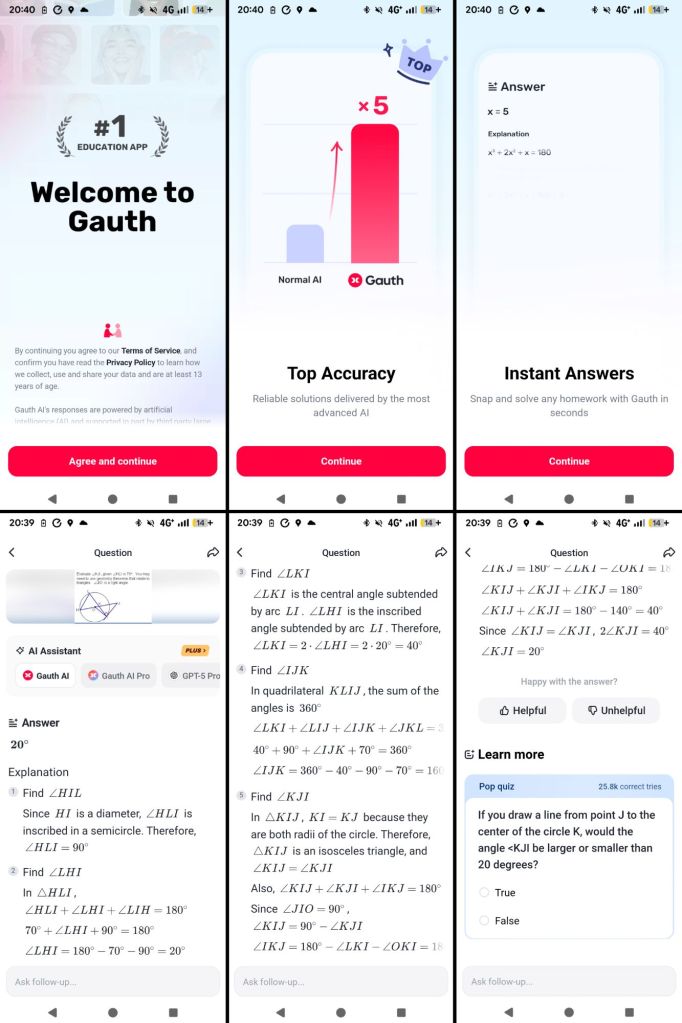
Worse still, in the screenshot below you can see a message from Gauth when you first open the camera. It says ‘ace your homework‘. It got the answer wrong, which is not a good way to ace your homework. This is a cheat engine, it doesn’t even try to hide that it is a cheat engine, and it does a poor job of it too.

Next in the list is Gemini, by Google. You can see from the screenshots below, this did end up giving the correct answer of 50°, but it took six screens of waffle to get there!

Next is Copilot, by Microsoft. This produced less waffle but also gave another incorrect answer of 70°.

And finally, we have Open AI’s ChatGPT, writing by far the least amount of waffle, but also getting it wrong and agreeing with Microsoft Copilot.

Four different AI engines, three different answers. 20°, 50° and 70° twice. Clearly, the tools available to young people are not yet ready to take over the process of thinking just yet.
Implications of AI on young people
I did a quick Google search and found article after article claiming that young people are negatively affected by the use of AI. It appears the consensus is that AI is indeed making young people less intelligent. That is a problem. A big problem.
Anecdotally, I can tell you that I have seen a sharp decline in student understanding in the last two years. It would not be appropriate for me to share specific details, but all year groups have delivered worryingly poor results. I am in the process of unpicking what is happening so that I can try to fix it. I suspect the rise of AI tools is partly responsible for students’ declining knowledge and understanding, but I do not have the evidence to back up that suspicion.
Now, I am duty-bound to tell you a story; a true story about a student I taught last year who managed to attain an A* Grade at A-Level. They were an exceptionally strong student, but there were times during the course that left me concerned, when their performance would sharply decline. I asked this student what they were doing for revision and how they were approaching their studies out of lessons. They told me that they made good use of Isaac Science, but if they could not answer a question then they asked an AI bot to explain the answer to them. They were outsourcing the thinking. The struggle is how we learn, but the struggle is uncomfortable and unpleasant. This student had not allowed themself to struggle, they had simply given up after a short period of difficulty. When I explained this to them, they objected. They claimed that they found it helpful when a worked solution was given by the AI bot, because they could learn from that solution. I pointed out to them that their performance had declined, and that the decline in their performance was correlated with their increased use of the AI bots. They abandoned using AI for their studies, and their performance improved again.
Isaac Science is a fabulous resource for studying and revision. It includes a repository of questions of various difficulty levels. Students attempt the questions and are told if they get the answer right or wrong. They may attempt questions as many times as they like. When they get the answer wrong, they are often given helpful hints. Some of the questions are exceptionally challenging; the sorts of questions that A-Level Students with aspirations to get an A* grade would attempt and spent more than an hour trying to solve. There are physics questions on Isaac Science that I would spend hours trying to solve too. There are also very straightforward questions, and everything in between. What you will not find on Isaac Science is the answers. This is by design. People learn best when they push themselves outside their comfort zone and struggle. The struggle is good for them. Simply looking up the answer is not going to help someone develop the knowledge, understanding, or skills required. AI bots that give worked solutions are denying students the opportunity to develop.
There is an argument that young people should be encouraged to learn how to use AI tools, because the workplaces of the future will rely heavily on the use of AI. I find this a particularly weak argument. To my ears, it is similar to the argument people might make in favour of giving very young children smartphones. Some people feel that young people should be exposed to technology as early as possible so that they can learn how to use it and not be left behind. If the technology in question was from the 1990s I might agree, but smartphones can be operated by trained chimpanzees. If a chimpanzee was trained to repair an 80486, where the CD-ROM drive connected to the PC via the sound card, but the sound card drivers were on a CD, then I would be impressed. Poking at a glass screen is not the same thing as understanding technology, and we know smartphones are harmful to young children. In the same way, anyone can type something into an AI prompt, or take a photograph of a problem and hope to get a solution from an AI bot. It requires little-to-no skill. Certainly, the skill of solving problems on paper with a pencil and the use of ones own brain far surpasses the skill of typing “solve this for me lol” into an AI prompt. Children will not be left behind the AI revolution by having to gain knowledge, understanding and problem solving skills themselves.
The genie if out of the bottle. AI is here, and students and young people have unfettered access to it. Given the harm it can cause to the mental capacity of the user, I feel it is comparable to gambling, alcohol, nicotine, and even pornography, all four of which are age-restricted. Should AI tools have an age restriction? Should under 18-year olds be denied access to them? My personal opinion is, yes. I believe we are now beginning to see the harm they cause. In 2018 a UK government study found that half of teenagers were addicted to smartphones. In 2025, that figure is likely to be higher. These devices are designed to be addictive and we know they are harmful. Why are they not age-restricted?
Voicing this view with students is sure to be met with the familiar conspiratorial side-eye. The students I teach know that there is something illicit about using AI bots to do their homework for them or to help them with their studies. When I raise this issue, I see the students glancing at each other, smirking. What do I know? To them, I am an old man, a Luddite who does not understand the issues they face. It is natural for teenagers to rebel. When I was younger, rebellion was surreptitiously drinking alcohol or sneakily smoking cigarettes. Is the use of AI more or less harmful than that? I do not know the answer, but as an adult it is my responsibility to try to protect young people from harm, and it is clear to me that there are no benefits to young people using AI bots, and plenty of ways that they cause harm.
No doubt AI tools such as face and voice recognition can be exceptionally useful, but children do not need access to them. I would call His Majesty’s Government to consider whether these tools should be age-restricted. I would also hope that society comes to view the users of generative AI tools as shortcuts to disguise a lack of original talent with the same disdain as it views those who participate in other harmful vices.
Reminder: Weekly Live Tuition Sessions!
SATURDAY 14th March 2026
| GCSE Physics | 9:30am | Generator effect |
| A-Level Physics | 10:30am | Multiple choice questions |
| GCSE Astronomy | 11:30am | Exploring starlight (1) |
If you wish to enrol on the tuition sessions and haven’t yet, then click enrol below
 Physics with Keith
I think AI is a catalyst; in a sense that you should use the tool with good intent for a good outcome. If you use it to just skip to answers, obviously you wouldn’t learn. But if you use it to intentionally structurally understand misconceptions, it can really propel where you struggle to understand. Yes, sometimes AI can be wrong, but so can humans, so what’s better is to gather as much information possible and form your own model of understanding (simply put just don’t solely rely on one source, just like you wouldn’t completely rely on 1 textbook). And what’s a better way to gain information than instant answers from an AI bot that gathers information from the world wide web, directly onto your phone?
LikeLike