Over the last few weeks I have been turning my Drill Spreadsheets into browser-based games! These work best using desktop-mode browsers (like on laptops, rather than phones), but I have tried to make them work for desktop and mobile browsers,
The games are all available to enrolled tutees via their course dashboards, or enrolled tutees can see all of the games by going here: https://physicswithkeith.com/resource-library/
In no particular order, here are some of the games I have made so far. I will continue to add more over the next few days and weeks. If students regularly develop the necessary skills by playing these games, they will improve their physics. This is active revision.
Get your calculators, pencil cases and 30cm clear plastic rules ready, grab some rough paper, and start mastering these skills!
Circuit Rules Drill
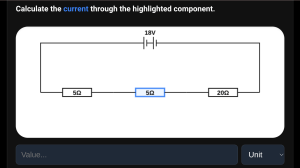
Calculate the current through a component or the potential difference across a component for different circuits. Perfect for GCSE students or a warm up exercise for A-Level students.
GCSE Definitions Drill
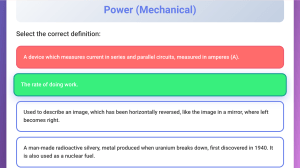
One of the key skills Physics students need is the ability to define and use technical vocabulary. This game has two different modes: one where you select from a multiple choice list and another where to type your answers.
Command Words Drill
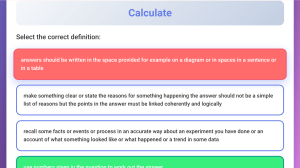
Students often lose marks because they to not give examiners the type of answer they want. This short game teaches students to look out for and recognise exam command words.
Formula Drill
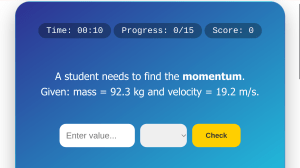
Another key skill for Physics students is the ability to choose the correct equation, rearrange it correctly, substitute numbers correctly and compute the answer correctly. This game gives students 15 random questions and gets them to perform straight-forward calculations. This is ideal for GCSE Physics students.
Micrometer Drill
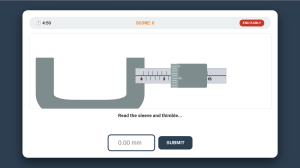
Often missed by teachers (and possibly course dependent), GCSE students are required to be able to read from micrometer scales! Even at A-Level, students can have difficulties with this skill. This game will help students practise until they never get it wrong.
Vernier Drill
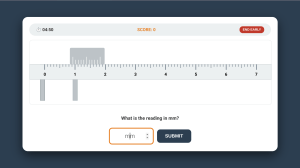
Here is another measuring instrument that GCSE and A-Level students should be able to use, but many find challenging; the Vernier calliper (or is it caliper?) Just as with the micrometer drill, this game will train the students so that they get it right every time.
Motion Graphs Drill
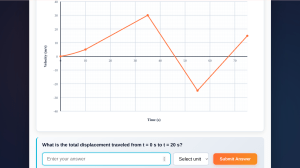
Another skill that is required for both GCSE and A-Level students; this game presents students with a motion graph and asks them a question about it. Students must be careful to check what the graph is actually telling them!
Vector Addition Drill
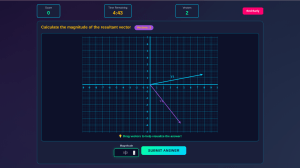
The graphical addition of 2-D vectors is essential at both GCSE and A-Level. This game also includes a more difficult mode where vectors are given as magnitudes and directions, so A-Level students can practice their trigonometry as well as adding vectors together. The more the student gets right, the harder the game becomes, pushing them ever forwards.
Moments in Equilibrium Drill
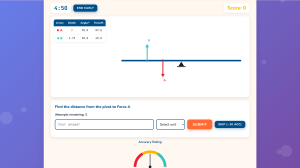
GCSE and A-Level students need to be able to solve equilibrium problems. This game has two game modes: a GCSE mode where forces are always perpendicular to a horizontal beam, and an A-Level mode where forces can be at any angle and students will have to compute perpendicular components before doing the equilibrium calculation. The more questions the student gets right, the harder this game gets, helping them to improve.
Lenses Drill
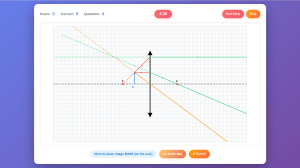
Drawing ray diagrams for convex and concave lenses is a required skill on many GCSE and A-Level Physics specifications. In this game, students have to draw the rays to locate the position of the image. This is an excellent game for developing this skill.
Lunar Disc Drill
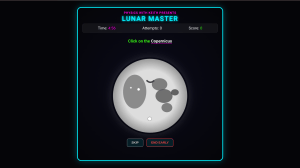
GCSE Astronomy students must be able to recognise and locate certain features of the lunar disc. This game will help students develop that skill. The simplified lunar disc helps students to be able to visualise the features on the real lunar disc.
Constellations Drill
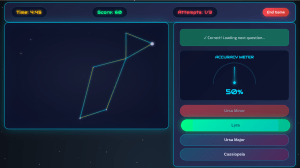
GCSE Astronomy students have to be able to recognise certain constellations and locate certain stars. This game is a lot of fun! After a few games of this, students will be pointing out constellations and stars with ease!
A-Level Circuit Rules Drill
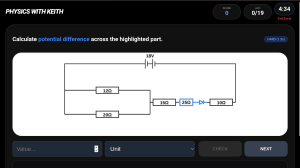
Similar to the GCSE Circuir Rules Drill, except this one includes diodes in forward and reverse bias! That significantly increases the challenge. This game will help A-Level students to become comfortable analysing even the most complex circuits.
Minkowski Spacetime Simulation
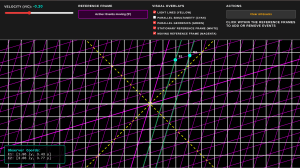
Being able to visualise length contractions and time dilations is tough. This little simulation (not really a game) will help students to get an intuitive understanding of Minkowski spacetime, so that peculiarities like the lack of absolute simultaneity becomes second-nature.
Lorentz Transformation Simulation
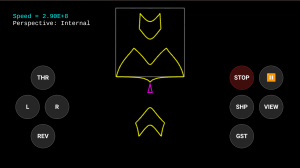
If visualising length contraction in 1-D is tough, imagine how much harder it is to visualise it in 2-D! This game (not really a game) involves you flying a spaceship around close to the speed of light and seeing how different object become warped. There are two different shapes; an array of rectangles (where only the corners warp, and they’re simply connected with straight lines) and a sparser array of larger squares (where the curvature of the straight lines is easy to see). If students play around with this for a few minutes, they’ll be seeing the universe like never before. This is an HTML5+JavaScript translation of a Python translation of my original QBASIC code, so it’s it is not very well optimised and may be slow on older computers.
TEM Magnetic Lens Simulation
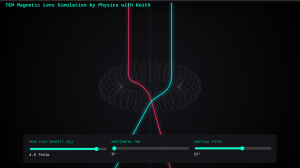
Students sitting the Turning Points option of A-Level Physics need to know how magnetic lenses work in transmission electron microscopes (TEMs). This simple simulation allows students to see the trajectory of two electron beams as the current through the magnetic lens is changed. You can rotate the view around to get an intuitive feel for what is happening.
Momentum Conservation Drill
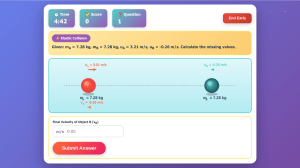
GCSE and A-Level students need to be able to calculate missing quantities for elastic and inelastic collisions. The difficulty of questions in this game scales up as the student gets answers correct, making it a fun way to develop this skill.
Snell’s Law Drill
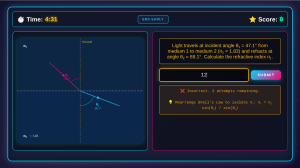
Many GCSE courses and all A-Level courses require students to be able to use Snell’s Law for refraction. This game gives students opportunities to practice using the Snell’s Law equation. Watch out for those total internal reflection questions!
Multistep Calculations Drill
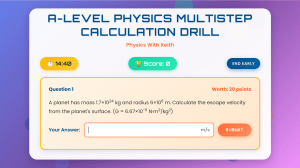
A skill that A-Level students must acquire is the ability to combine different parts of the course to solve problems. In this game, there are loads of combinations of equations from different topics combined in different contexts to give students practice choosing the right equations and, more importantly, using them correctly too. This has a robust hints system to support developing students.
Reminder: Weekly Live Tuition Sessions!
SATURDAY 14th March 2026
| GCSE Physics | 9:30am | Generator effect |
| A-Level Physics | 10:30am | Multiple choice questions |
| GCSE Astronomy | 11:30am | Exploring starlight (1) |
If you wish to enrol on the tuition sessions and haven’t yet, then click enrol below
 Physics with Keith