What does good quality feedback look like?
For anyone to improve in a skill, they need feedback from an expert. Whether playing a musical instrument or racing a sailing dinghy or solving problems in physics, improvement is not automatic.
In order to improve, a student must get things wrong, and have their misconceptions and mistakes highlighted. When a student attempts a question, they can easily find the answer without much effort. They can find out what they got wrong and what they got right, but is that enough?
Feedback requires more than just an identification of correct and incorrect answers. Misconceptions are harder to identify and unpick. The best feedback is given by people who have had to work through the same misconceptions themselves at some point.
How thorough does written feedback have to be?

If every mistake was identified, it would likely be demoralising for the student. Too much red ink can also be overwhelming, so the feedback simply does not get read. If a long time has passed since the work was done before the students get written feedback from it, that can also reduce the impact.
So the most valuable written feedback is detailed enough to be useful, but not so detailed as to be overwhelming and delayed. It’s a fine line.
Does written feedback have to be words?
Sounds like an odd question, but written can mean a few things. Does using the letters sp to indicate a spelling mistake count as written feedback? What about circling the command word in the question if the student has not answered the question correctly? What about just putting a question mark next to a description that does not make sense?
In my view, symbolic feedback and annotations are far more useful than writing lots of words. They are quicker do, which makes the feedback more timely. They are easier for the student to digest, they provoke the student to think about what the feedback means. The student is less likely to become overwhelmed by there being too much red ink on their page, so they will be more receptive to the feedback too.
Even better is symbolic and abbreviated feedback that is accompanied by verbal feedback.
How can a teacher give useful verbal feedback to every student?
Sometimes, most (or many) students make the same mistakes. Experienced teachers can anticipate these mistakes and know what to look out for. If and when the teacher sees these mistakes, they can address all of the students together.
The benefit of verbal feedback is that it’s immediate and tailored to the particular issues presented. It is far more challenging to give useful verbal feedback to each individual student if there are too many of them in the class, so a combination of written feedback (using annotations and abbreviations) and whole-group verbal feedback is the most effective.
What do I do?
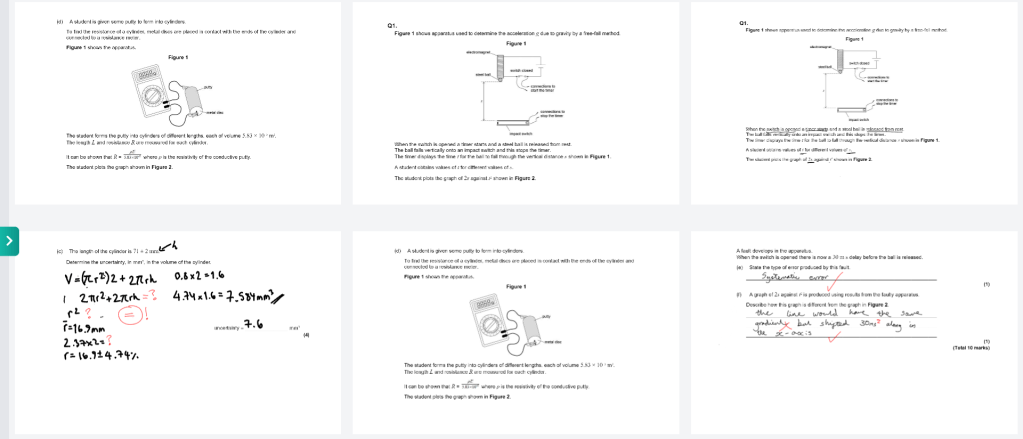
My online tuition sessions involve a combination of immediate written feedback and whole-group verbal feedback, exactly as described above. Students use a digital whiteboard to answer questions, allowing me to see each individual’s work in real time. Because students cannot see what others are writing, they don’t have to feel embarrassed about making mistakes. In fact, they can even use the whiteboard anonymously!
Reminder: weekly tuition sessions!
Saturday 17th October 2026
| GCSE Physics | 9:30am | Topic: Wave basics |
| A-Level Physics | 10:30am | Topic: Nuclear radius |
| GCSE Astronomy | 11:30am | Topic: Time and Earth-Moon-Sun Cycles (2) |
If you wish to enrol on the tuition sessions and haven’t yet, then click the button below