Improving Written Answers in Physics Examinations
Introduction
When answering examination questions, there are some things you should look out for. I believe that Physics examinations are amongst the most straightforward. Often, it is not the physics that causes you to lose marks, but how you answer questions. Mastering physics exam command words is one of the easiest ways to secure full marks in your GCSE and A-Level Physics examinations.
Essential Physics Exam Command Words Explained
You must be mindful of the command words used for each part of the question. Unlike some subjects, where a single question might be worth 25 marks and require a substantial amount of writing, the maximum number of marks given in a Physics question is 6, and most questions are worth far fewer. I’ve based this guide on the official guidance from AQA.
State/give/name/identify
These questions require a short response, sometimes as little as one word, often just a few words. These tend to test basic knowledge, and do not require you to give protracted explanations or link ideas together. You do not get extra marks for writing more detailed answers than are necessary.
List
Just like state, but these questions require more than one response. You must be very careful to only include the number of responses demanded. If the question states ‘list three things’, examiners will apply the list principle. The examiners will add a mark for each correct response up to the maximum number of marks, and then remove a mark for each incorrect response back down to zero. For example, if the question asks you to list three things, and you give four correct answers and one incorrect, you are awarded two marks; four correct answers and three incorrect answers scores zero marks.
Label/annotate
These questions require very simple names or labels to be added directly on diagrams or graphs. Again, these questions are difficult to mess up if you can remember the key information.
Calculate
Do not assume that answers will require a single equation to be used and immediately reach for the formula sheet. In fact, the best students don’t need to use the formula sheet at all, so see it as a safety net, not a crutch.
Look out for unit prefixes for every value, unit conversions (especially with units of time) and numbers that are implied but not stated (such as the gravitational field strength on Earth). Work symbolically first. At GCSE Level, there is usually a mark for substitution and a mark for rearrangement, so do not perform both of these steps as a single step. Show the examiner each of the steps separately.
Look out for significant figures; at GCSE Level you will be told if they are being assessed, but not necessarily at A-Level because it should be second-nature. Always give the final answer on the line rounded to the lowest precision (i.e. number of significant figures) of the numbers used in the calculation. Always include the unrounded answer in your working in case you need to use the answer in a subsequent calculation. Check the units, check the unit prefixes, check the question to ensure you’ve correctly answered it. Show every stage of your working.
Determine
These require a calculation, but often the data needs to be taken from somewhere else, such as a graph or diagram. Annotate the graph or diagram to show where the data has come from. Everything else from calculate applies here too.
Show that
These are questions where even very good students lose marks. The command word does not mean ‘convince yourself that‘, it’s not asking you to check the examiner’s answer. The question is testing your ability to teach, to communicate clearly, to elucidate physics ideas to someone who is intelligent enough to understand them but lacks the knowledge. You should imagine that you are writing an answer to teach someone else how to perform the calculation.
The best students clearly annotate the steps in their answers. It is important that symbols are clearly written (v must not be mistaken for u, M must not be mistaken for m). If you are asked to show that a quantity has a particular value, then you must give your answer to at least one additional significant figure to the value for the answer that you are given in the question. Never use the target value in the calculation.
Measure/plot/sketch/draw
These questions tend to examine practical skills. You should develop these skills by doing real practical work in the laboratory and correctly writing up your results. As long as you have drawn enough graphs and diagrams, you should be fine.
Describe
Now we’re getting to the more challenging questions to answer. These questions require a clear account of what happens or what is observed. Look out for the word ‘changes‘ in the question, such as ‘describe how XXX changes‘. ‘Changes‘ is a vague examiner word used as an invitation to you to state whether a value increases or decreases. Detail is important here, you should give as much detail as possible. Often it’s the obvious facts that get forgotten about, because you think they’re too obvious to state. You must make sure you don’t accidentally start to give physics reasons in your answers. Describe questions ask what happened, but they are not interested in why it happened.
Explain
Explanations usually require you to start from first principles. Importantly, you must state those principles. Newton’s first law? State it, with its definition. Newton’s second law? State it, with its definition. Conservation of energy? State it, with its definition. String together parts of your explanation. I.e., because of X, then Y happens. Because of Y, then Z happens. You must make sure there are no logical steps skipped. Changes of velocity are accelerations, accelerations are caused by resultant forces, resultant forces are nonzero if forces do not balance, state the forces, for example. Keep sentences short, avoid adverbs and adjectives, and make sure correct physics language is used.
Compare
You have to identify similarities and differences, not just describe one thing or the other. You must make sure that both things are mentioned, such as ‘thing XXX has this, but thing YYY has this instead‘. Nothing is too simple or obvious to be included.
Deduce
Logical conclusions need to be drawn, usually by using data from graphs or diagrams. These sort of questions sit somewhere beyond ‘explain‘ questions, because you have to include elements of the explanation with other elements taken from elsewhere in the question.
Use
If you do not use the information that you are told to use, you cannot get full credit. That is the most important thing to keep in mind when you answer these questions.
Analyse
With these questions, complex information has to be broken down into smaller elements. Usually, you have to identify mathematical relationships between variables. At GCSE Level, this is usually either a linear relationship, directly proportional relationship, or an inversely proportional relationship. At A-Level, power laws and exponential relationships are included as well. Remember, variables are only directly proportional if a graph of one vs the other is a straight line passing through the real origin (0,0). For inverse proportionalities, the product of the independent and dependent variables will always be equal to the same constant. You have to be able to identify the pattern or trend, and describe it using the correct mathematical and physics language.
Suggest
There may be no single answer that you can recite, you might be able to get full credit for one of two contradictory answers as long as the explanation is thorough and correct. These questions usually examine unfamiliar contexts. Students who have mastered the fundamentals usually do better in these questions.
Evaluate
You need to reach a conclusion by balancing pros and cons, or strengths and weaknesses. Evidence needs to be used to support the conclusion. Again, this sort of question requires knowledge of lots of areas of the physics curriculum. You should frame answers systematically in terms of the two contrasting aspects that are being evaluated, similar to compare but with a conclusion being drawn.
Discuss
These sort of questions do not seem to be used at GCSE Level, but do feature at A-Level. Multiple aspects have to be explored in these questions, whether it’s exploring perspectives or mechanisms or factors relating to some context. Broad and deep knowledge is required for success in these questions. You must make reference to the individual topics that are being assimilated, using the correct technical language. Again, many students forget to include the basics. There is no need to ramble or waffle in these questions. As long as you focus on the key elements that need to be put together to answer the questions, and explore each of these elements in detail, you should be fine.
Justify
You need to use evidence in your answer, either from calculations or from reasoning based on Physics fundamentals. Usually you will have already stated an answer or a hypothesis, and this part of the question works as an explanation for that answer.
Improve your examination technique
Understanding command words is one of the quickest ways to improve your grade. Once you know what the examiner is actually asking for, you stop wasting time writing unnecessary detail and focus entirely on scoring the available marks.
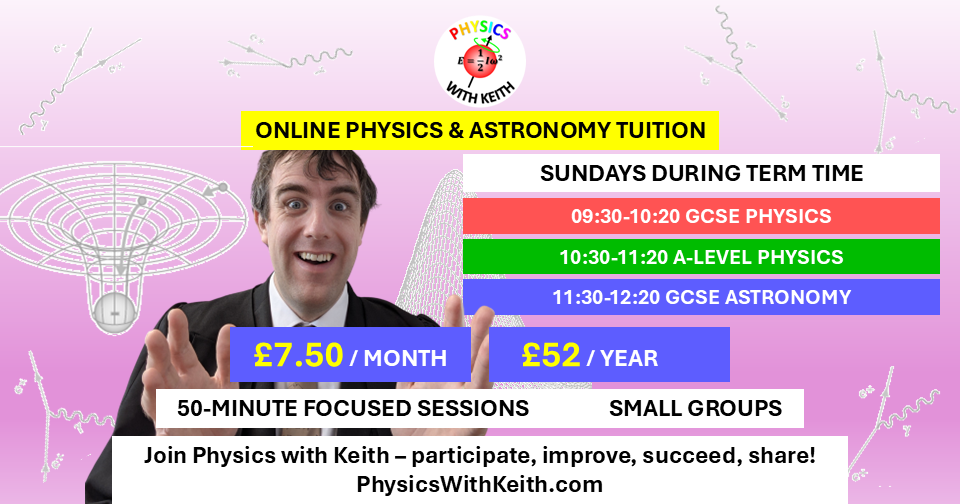
If you would like structured, week-by-week support to put these principles into practice, consider joining my online physics tuition courses:
- Targeted Exam Practice: We dissect real GCSE and A-Level exam questions together, focusing on precise phrasing and avoiding common mark-losing pitfalls.
- Core Physics & Mathematics: Work through tricky conceptual ideas, equation rearrangements, derivations, and practical skills step-by-step.
- Live Interactive Sessions: Ask questions in real time and get direct, immediate guidance on your work.
Whether you’re aiming for top grades at A-Level or building your confidence at GCSE, live weekly tuition provides the structure and regular practice needed to succeed.
Find out more about weekly online tuition and enrol here →
Reminder: weekly tuition sessions!
Saturday 10th October 2026
| GCSE Physics | 9:30am | Topic: Energy and power |
| A-Level Physics | 10:30am | Topic: Quantum phenomena |
| GCSE Astronomy | 11:30am | Topic: Time and Earth-Moon-Sun Cycles (1) |
If you wish to enrol on the tuition sessions and haven’t yet, then click the button below