Teacher retention and half-life
I saw a video by Lee Parkinson MBE (AKA “ICT With Mr P”) in which he stated that 40000 teachers in the UK leave every year due to workload. That sounded like a staggering number, so I decided to direct my procrastination time to checking it out.
A quick online search brought me to the National Foundation for Educational Research (NFER) and their 2026 annual report. It’s only 28 pages long so you can read the whole thing if you like.
Some things that I noticed were that recruitment of Physics teachers last year was 22% below the target, yet recruitment of Mathematics teachers was 14% above target, recruitment of Chemistry teachers was 20% above target, and recruitment of biology teachers was 52% above target. On the face of it, the picture looks positive, however when the recruitment of PE teachers is 104% above target there is a very real risk that PE teachers will be used to teach Physics classes in some schools. I feel specialist teachers should teach within their specialisms. When biologists and PE teachers are teaching physics, there is the risk that the subtext to the students will be “physics is not as worth a subject.” Unconscious bias is very difficult to avoid, and I will readily admit that if I was made to teach biology I would do a shoddy job of it and would probably discourage students from pursuing biology further.
The report notes that the recruitment of physics teachers at a rate that is 22% below what is needed is actually the highest recruitment rate in the subject since 2016/2017. The report credits this success (for those using screen readers, I made the word success italicised to indicate sarcasm) to international recruitment efforts. Recruitment is still 22% below what is needed despite incentives to appoint teachers from abroad. Simple put, we are not training enough physics teachers. Why not? There are not enough physicists in this country that want to teach.
The bursary to biologists to train to be teachers has been slashed this year, so NFER are predicting that recruitment will fail to meet the target in biology next year. Chemists will continue to be abundant.
Pulling numbers out of the report, there are approximately 466000 UK full-time equivalent teachers in the UK. 40000 leaving equates to 8.6% last year. Now, let’s do some modelling.
Let’s model teacher retention as an exponential decay. This model has some drawbacks; for example, the proportion of people still teaching 100 years after they started will not be zero. Indeed, the proportion of people still teaching 1000 years after they started will not be zero using this model, but it’s a good place to start.
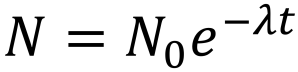
Where N is the number of teachers still teaching t years after they started, N₀ is the number of teachers who were teaching when t = 0, and λ is the decay constant. The decay constant is the probability a teacher will leave within a year, which we are setting at 0.086 (8.6%).
N₀ = 466000 teachers. If we set N = 0.5 N₀, then t will be the half-life.
Solving this equation gives a half-life of 8 years. That is to say, every 8 years, half of teachers have left teaching. I have been teaching for 16 years, so only a quarter of the teachers who started teaching when I started teaching are still teaching.
What about science teachers? Using the same calculation but adjusting for the number of science teachers in the profession and the number who left last year, the half-life was 6.7 years. Only 19.3% of science teachers who started teaching when I started teaching are still teaching.
Is that accurate? It is hard to say. For a start, we are counting full-time equivalent teachers, so two part-time teachers, each on 50% contracts, together count as one. The Department for Education (DfE) has slightly different numbers published in June 2026. They state a UK Teaching full-time equivalent workforce of 466372 and 38632 leaving. That’s a decay constant of 82.8%, giving a half-life of 8.37 years (slightly longer), but they seem to be including ‘non-qualified teachers’ in those statistics.
Interestingly, in my Physics department, we have only had two colleagues leave teaching. One of those ended up working at the University of Cambridge on a high-school and A-Level Physics educational programme in a high up position, so I think that counts as a promotion! The other left for personal reasons unrelated to the job. I have had two colleagues stick by me all the way through. My department seems to be the exception to the rule. I’m tremendously grateful to all my colleagues for making my job easier!
The DfE are eager to point out median pay and pay rises in their report, but it is very apparent that the pay was stagnant for well over a decade and even now the pay rises are below the increase in the cost of living, so in real terms, pay has been cut. It seems to me that incentives for training new Physics teachers are not working as they should, and retention of teachers in general is a problem.
Now, I can think of three easy solutions.
- Abolish Ofsted. We don’t need reforms to inspections, they should be entirely about support and advice, and not at all about publicising judgements. Ofsted does not improve education standards, it simple increases accountability. With increasing accountability comes increasing workload, which decreases the time teachers can spend doing what really matters.
- Give immediate substantial pay rises. Politicians voted to give themselves a 10% pay rise just after the pandemic because of the ‘increase in their workload’. Teachers had to overhaul schemes of work with zero notice, retrain in online teaching, deliver online lessons, and make one-to-one phone calls with students and parents regularly to check on their wellbeing, all while increasing record keeping of the additional work. Our pay rise was way below inflation. If you want to recruit and retrain teachers, make the profession attractive. That leads me to…
- Decrease work load. The NFER states that 50.1 hours per week is the average for full time teachers. We are paid for 32.5 hours per week. Would you agree to work 17.6 hours per week without pay? No, holidays do not compensate because a) we cannot choose when they happen, and travel companies put prices up significantly during school holidays, b) most teachers spend time during holidays catching up with work they could not complete during those 50.1 hours per week during term times (yep, even that isn’t enough time for the workload), and c) many teachers give up holiday time for school trips (which we do not get paid to run), results days (which we do not get paid to attend), sports fixtures (which we do not get paid to support). We do not get 13 weeks holiday per year, we get 13 weeks non-contact time per year. Work carries on. Unpaid.
This post was not intended to be doom-and-gloom. I love my work, and I cannot imagine doing anything else. Most of my colleagues feel the same way. It is the most rewarding job in the world in many many ways, but it can be difficult to see the people you studied with at university earning triple your salary and doing fewer hours with far fewer grey hairs.
Value your teachers.