Writing practical methods in Physics exams
Writing practical methods can be straightforward if you follow this simple recipe:
- What is the independent variable? How are you changing it?
- What are the dependent variables?
- What are the control variables? How are you ensuring these do not change?
- What are you measuring? What instruments are you using? How are you using them?
- Are you taking repeats? Discarding anomalies? Computing means?
- Are you processing the data? Drawing graphs?
- Are there any safety considerations?
The same recipe works for GCSE Physics and A-Level Physics. In the video below, I work through two six-mark level assessed practical methods questions from AQA GCSE Physics. You may find it useful!
There are other top tips within the video above, so it is worth the investment of 15 minutes and 16 seconds.
Waiting list opens soon!
Don’t forget, on 15th May the waiting list for the 2026-2027 Academic Year opens! I’m limiting participation spaces next year so that I can maintain the same level of high-quality feedback. Individuals on the waiting list will get a head start enrolling. Given the limited number of spaces, I think it is definitely worth being on the waiting list!
Tutees who are enrolled as participants will be able to participate in the live sessions each week and get live individual feedback from me. While these tutees are working, I watch what they write and use my red pen to guide them. This is far more effective than simply giving a score or giving a correct answer. This approach to tuition gives tutees access to the insights of a qualified and experienced examiner and Physics teacher (i.e. me) every week during term time!
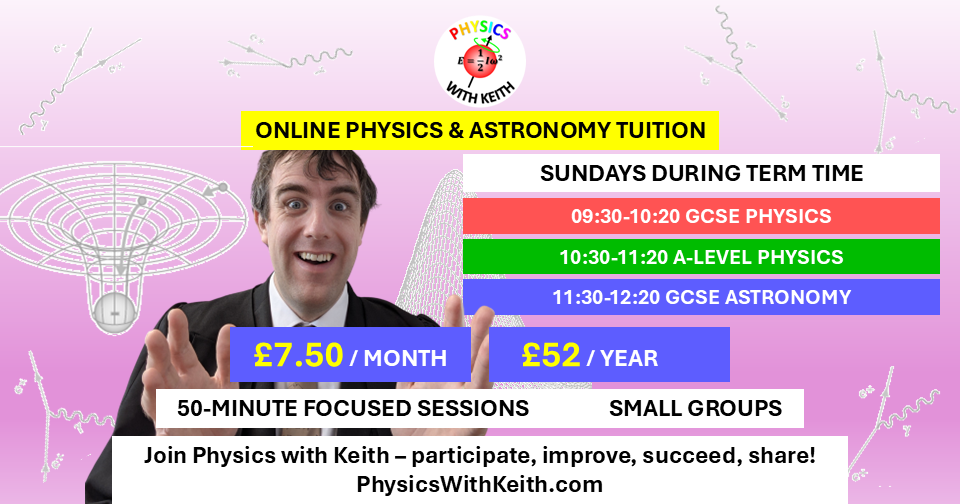
Reminder: weekly tuition sessions!
Saturday 17th October 2026
| GCSE Physics | 9:30am | Topic: Wave basics |
| A-Level Physics | 10:30am | Topic: Nuclear radius |
| GCSE Astronomy | 11:30am | Topic: Time and Earth-Moon-Sun Cycles (2) |
If you wish to enrol on the tuition sessions and haven’t yet, then click the button below