Why use a human tutor in 2026?
It is 2026, and students can get easy access to an AI Physics tutor for free, or for very little cost. Why should students still consider using a human tutor? AI tutors are more convenient, being accessible 24/7. They are faster, giving answers almost immediately. AI tutors apparently never make a mistake and never hesitate. They sound perfect! So why would students or parents continue to spend more money on a human tutor?
I obviously have a horse in the race, so to speak. I’ve been teaching since 2010 and I have seen changes in education, but none have been so fast and potentially transformative as the growth in easily-accessible AI tools. Despite all the apparent benefits of AI revision tools and AI tutors, I still have lots of students signing up to participate in my Physics With Keith tuition sessions. So what is it that attracts them to a human tutor? Is AI my competitor, or is it a digital ally that can form part of the optimal study solution?
The good
AI tutors can provide immediate feedback. If a student makes a mistake, the AI can ostensibly immediately identify the incorrect mathematics or physics and provide a correct solution. Students can request for steps to be broken down, and they can work at their own pace.
AI tutors never run out of tuition spaces. You can guarantee that if you log on and ask a question, you can get an answer. You do not have to wait a week for the next tuition session, the AI tutor is there, ready to assist.
AI tutors can be easily personalised. They can learn a student’s particular weakness and design a curriculum to address it. If a student has a particular accessibility requirement, the AI tutor can immediately adapt to that.
AI tutors are cheap. One of the most popular AI tutors costs students about £3-£4 per month (depending on the USD-GBP exchange rate). That makes AI tutors incredibly accessible, leveling the playing field and promoting social mobility.
The bad
Now that is out of the way, let’s examine some of the drawbacks, drawing quotes from some recent articles.
One article says AI tutoring “raises concerns regarding digital fatigue, loneliness, technostress, and reduced face-to-face interactions. Over-reliance on AI may diminish interpersonal skills and emotional intelligence, leading to social isolation and anxiety.” (Klimova and Pikhart, 2025)
I think I can agree with that. As a classroom teacher I work with young people every day, and I have seen the growth in anxiety amongst them. Almost all in this generation carries a communication device in their pocket, and yet feel more isolated than ever before. Communicating with an AI feels fake. You start to notice the repetition of key phrases, the over-abundance of praise and positivity, the unending agreement with whatever is said. It all has an effect.
Another article states, “in addition to bias, artificial intelligence may generate misinformation. The data that AI draws from may have errors, be outdated, or spread misinformation. Neither students nor teachers should assume that information provided by AI is accurate.” (Walden University, 2025)
I see this often. Most AI tools students access are simply LLMs, which are trained on data found across the internet. In Physics, we have a problem. Half of the articles out there are incorrect physics, and the other half are correcting that incorrect physics (and in doing so, include the incorrect physics as part of the article), so the incorrect physics may appear twice as often as the correct physics. Okay, I made those statistics up, but the point remains, I have seen again and again AI generated infographics with incorrect physics on them. I’ve written blog posts about it before, such as this one about AI slop images and this one where AI could not solve a basic GCSE Mathematics question.
The AI tools present answers with such confidence that it easy for students to be duped. A key skill to avoid falling into the trap of assuming AI is always correct is to develop critical thinking and problem-solving skills. However, another article states “some experts have raised concerns that AI could reduce learners’ ability to problem-solve by themselves and could stifle the development of some skills” (Smith and Gajjar, 2024)
Anecdotally, I can say I have seen this myself. A very able student’s performance last year dipped. When I spoke with them to ask them what was happening, I discovered that they had started to use AI to explain to them how to solve problems when they were unable to solve them themselves. The student did not allow themselves time to struggle, and consequently they were not actually learning how to solve problems at all. Being shown a recipe does not make one a master baker; it’s the same idea here. The student took my advice, allowed themselves to struggle, and their performance improved again. It is interesting that their performance improved but their homework scores declined, because they were allowing themselves to struggle and sometimes not being able to answer the homework questions. That struggle was beneficial in ways that getting 100% correct in the homework was not.
Anecdotes aside, I decided to look for some statistics to back up the anti-AI rhetoric.
One article stated that “62% of the students said [AI] has had a negative impact on their skills and development at school, while one in four of the students agreed that AI ‘makes it too easy for me to find the answers without doing the work myself'” (Adams, 2025)
And another article was based on actual data, not just feelings and thoughts, stating that students using AI tutors performed 17% worse on follow-up exams, and had no long-term learning gains. The same article said that students using AI tutors overestimated their learning despite lower outcomes (Bastani et al., 2025).
The ugly
During the Second World War, everyone lived with a deep sense of dread about the prospect of an invading army bombing their home or attacking their country. During the Cold War, everyone lived with a deep sense of dread about mutually assured destruction and nuclear winter. Every generation has had something that has hung over them and given them a sense of existential dread and doom. For this generation, I fear that it is the rise of AI. Artificial Intelligence has the potential to be useful, but just like the internet was instrumental in the closure of so many public libraries, AI may well be instrumental in broadening social division and making it harder for people to find work.
One reason businesses are keen to use AI is because it is cheaper than hiring actual humans to do work. Business decision are made to maximise profit. The inclusion of AI tools in many industries is simply a way to increase profit for shareholders at the expense of an income for the majority. AI is the opposite of Robin Hood, stealing from the poor to give to the rich.
Just like automated tills at supermarkets have reduced the number of staff that need to be employed, so AI will remove jobs that the majority of people can do. Work becomes harder to find. AI will one day be maintaining AI, so even computer science roles will be redundant. Maybe I am myself subject to the slippery slope fallacy here, but I cannot help but feel a sense of impending doom and existential dread at the rise of AI. If I am feeling it, young people are likely to be feeling it too.
What sort of future are we preparing young people for when any and all jobs can be replaced with AI? I think it is naive to believe any job is safe. A Catholic Advocacy group even released an AI Priest (although the technology wasn’t quite ready, but it won’t be long).
I see robots that can move and manipulate objects better than humans can, they never tire, they never need to sleep. Combine developments in robotics with developments in AI and you have a potentially cheaper workforce. It is no wonder the current generation feels lonely and anxious.
Doom and gloom, but the genie is out of the bottle. AI is not going to go away. Businesses have found a new way to make more money. I need to be careful here not to turn this article into a political rant.
Conclusion
So back to the initial question: why use a human tutor in 2026? Here are a few reasons.
- Human tutors are slow (relatively). This gives students time to think for themselves and develop problem solving skills and resilience.
- Human tutors make mistakes (occasionally). This provides a role model to students, so they can see how to handle failure constructively, and how to develop humility.
- Human tutors are not available 24/7. This makes tutoring sessions an event to look forward to, a time carved out specifically for the task of improving in one particular subject area. This helps students to develop time keeping skills, organisation and self-discipline.
- Human tutors have a personality and a sense of humour. Students who are missing out on developing interpersonal skills can develop them in the background, so to speak.
- Human tutors can empathise with students. AI has not had to struggle to learn something. Students know that tutors, at some point, did not understand the topic themselves and had to learn it. This makes them more relatable.
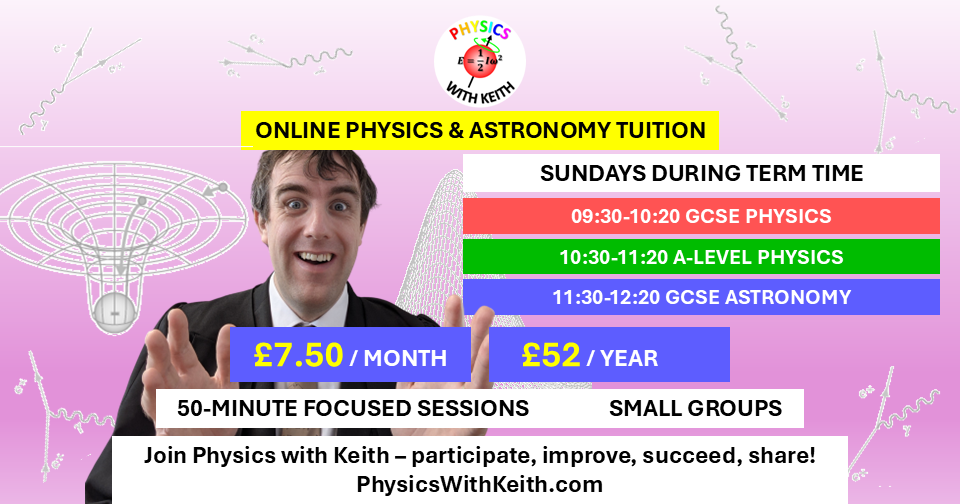
- Human tutors are more expensive. Why is this a good thing? Accountability. If a parent is paying very little, the student is not so inclined to actually use the service. If a parent is paying more, they are going to want to see that the student is turning up, and that they are actively engaging.
I am not saying “AI is evil, it should be avoided at all costs.” I am saying it may be useful as part of a learning solution, but it does not replace the human connection. And if my Physics Tuition sessions are just too expensive, then please do contact me.
References
Klimova, B. and Pikhart, M. (2025). Exploring the effects of artificial intelligence on student and academic well-being in higher education: A mini-review. Frontiers in Psychology, [online] 16(16). doi:https://doi.org/10.3389/fpsyg.2025.1498132.
Walden University (2025). 5 Pros and Cons of AI in the Education Sector. [online] http://www.waldenu.edu. Available at: https://www.waldenu.edu/programs/education/resource/five-pros-and-cons-of-ai-in-the-education-sector.
Smith, B. and Gajjar, D. (2024). Artificial intelligence: education and impacts on children and young people. [online] POST. Available at: https://post.parliament.uk/artificial-intelligence-education-and-impacts-on-children-and-young-people/#_edn14 [Accessed 4 May 2026].
Adams, R. (2025). Pupils fear AI is eroding their ability to study, research finds. [online] the Guardian. Available at: https://www.theguardian.com/technology/2025/oct/15/pupils-fear-ai-eroding-study-ability-research.
Bastani, H., Bastani, O., Alp Sungu, Ge, H., Özge Kabakcı and Mariman, R. (2025). Generative AI without guardrails can harm learning: Evidence from high school mathematics. Proceedings of the National Academy of Sciences, 122(26). doi:https://doi.org/10.1073/pnas.2422633122.
Reminder: weekly tuition sessions!
Saturday 17th October 2026
| GCSE Physics | 9:30am | Topic: Wave basics |
| A-Level Physics | 10:30am | Topic: Nuclear radius |
| GCSE Astronomy | 11:30am | Topic: Time and Earth-Moon-Sun Cycles (2) |
If you wish to enrol on the tuition sessions and haven’t yet, then click the button below